Supporters of income tax change measure submit signatures for Colorado ballot
The proposal seeks to cut taxes for 97% of Coloradans, while raising taxes on households making over $500,000 to help fund healthcare, education and early childhood programs

Robert Tann/Post Independent
Supporters of an effort to replace Colorado’s flat-income tax with higher taxes on wealthier individuals say they’ve collected over 157,000 signatures to get the measure on the November ballot.
Protect Colorado’s Future, a coalition of more than a dozen statewide advocacy groups, said it had delivered the signatures Monday, Aug. 3, to the Colorado Secretary of State’s Office, which will now review the signatures and determine whether the measure will be placed on this year’s ballot.
The coalition needed to collect at least 124,238 valid signatures from registered state voters, including signatures from at least 2% of all registered voters from each of Colorado’s 35 state Senate districts.
“Every signature represents a Coloradan who believes our tax system can be fairer,” said Kathy White, executive director of the Colorado Fiscal Institute, a progressive organization that is part of the Protect Colorado’s Future coalition, in a statement. “No matter what happens at the ballot or before, thousands of people have laid the groundwork for a future where working people pay less and the wealthiest pay their fair share. None of these hours, conversations or miles were for nothing. They showed what we can build when we work together.”
Protect Colorado’s Future said it relied on 1,000 volunteers to gather nearly 70% of all its signatures, while the rest were collected by paid petition gathering firms. Campaign finance filings with the secretary of state’s office show the group has raised $401,007 and spent $227,152, with major donors including the Colorado Center on Law and Policy, The Bell Policy Center and Great Education Colorado.
Conservative groups — generally opposed to tax increases — have vowed to fight the measure, which they argue threatens to drive out wealthier Coloradans, burden businesses and lead to less overall revenue for the state.
Advance Colorado, which has helped several conservative causes onto voters’ ballots, has submitted signatures for a competing measure this November that would keep the state’s current income tax rate capped at 4.4%.
Colorado is currently one of roughly a dozen states with a flat income tax — meaning all households pay the same tax rate, regardless of income — and the state has one of the lowest rates in the country, according to the Tax Foundation.
If the tax measure is approved this November, it would implement what supporters call a graduated income tax that would reduce taxes for some of the state’s lowest earners, while ratcheting up taxes on those making $500,000 or more annually.
The tax rate would be cut from 4.4% to as little as 3.7% for someone’s first $25,000 of annual income, with income between $25,001 and $100,000 being taxed at 4.2%. Income between $100,001 and $500,000 would still be taxed at 4.4%
For a household making $95,470 — the state’s median income, according to U.S. Census data — the new rate would reduce annual income taxes by $316, according to a calculator on the coalition’s website.
The tax rate would increase to 7.4% for households earning over $500,000, and up to 8.4% for those earning $1 million or more. Under those changes, a household making $1 million annually would pay $15,925 more in income taxes, according to the coalition’s calculator.
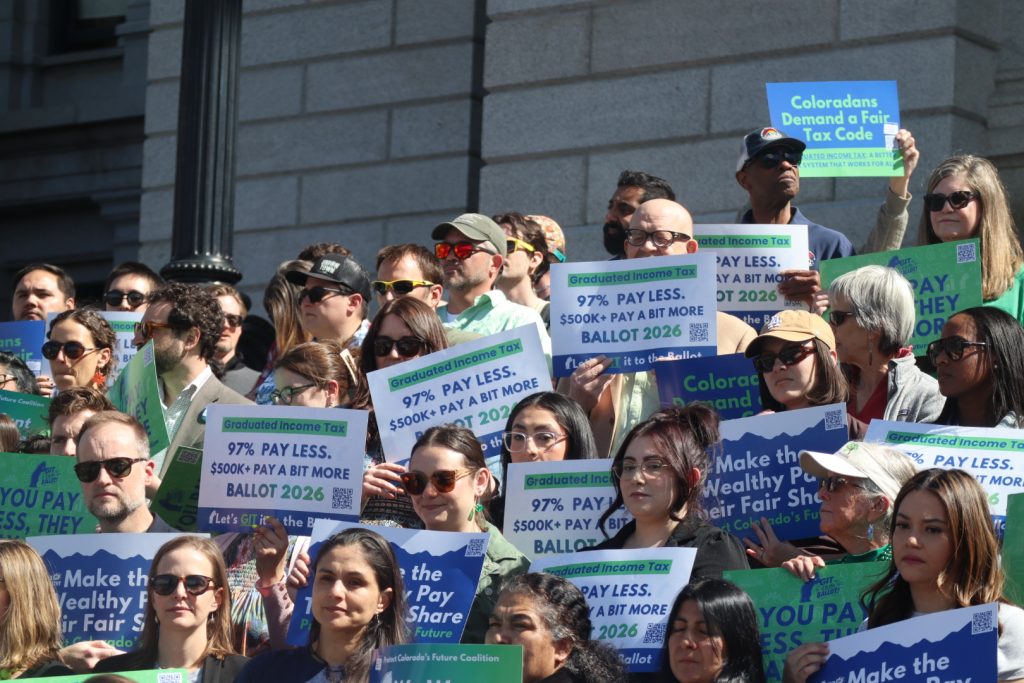
Supporters of the effort say the changes will provide tax cuts for 97% of Coloradans while raising roughly $2 billion more annually from higher earners to boost funding for healthcare, education and early childhood programs. They say such investments are desperately needed amid the state’s chronic funding challenges.
Lawmakers have had to close billion-dollar deficits over the past two years, with legislators this spring approving a state budget that cut Medicaid, affordable housing and other key government programs.
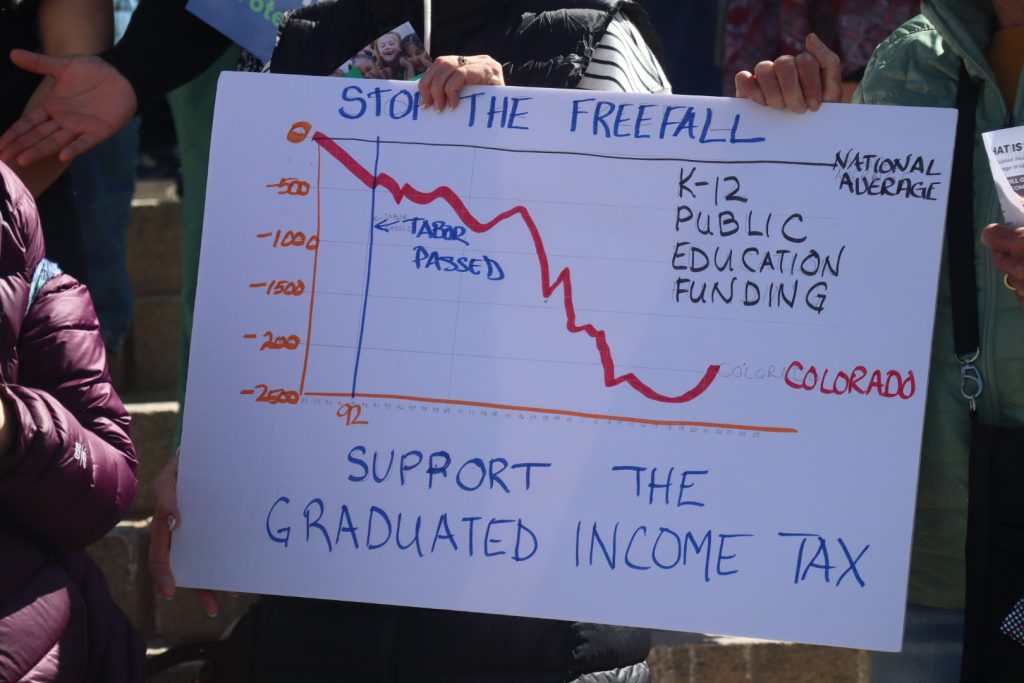
The budget shortfalls are partly due to revenue constraints imposed by the Taxpayer’s Bill of Rights, a 1992 voter-approved amendment to the Colorado Constitution that limits government tax revenue to the rate of population growth plus inflation. Other factors, such as overspending on certain programs and dried-up pandemic-era relief money, have also contributed to the state’s fiscal woes.
Conservative groups — generally opposed to tax increases — have vowed to fight the measure, which they argue threatens to drive out wealthier Coloradans, burden businesses and lead to less overall revenue for the state.
Advance Colorado delivered nearly 190,000 signatures, which are under review, to place its counter measure capping the state’s income tax rate on the November ballot.
As of publication, the group has not responded to a request for comment. The group’s president, Michael Fields, said in a July 28 post on X that Coloradans “don’t want increased taxes on small businesses, seniors and veterans.” Fields, in another post, said Advance Colorado’s tax cap proposal “is so popular that we turned in signatures well before the deadline!”
Advance Colorado submitted its signatures on July 15, more than two weeks before the Aug. 3 deadline, while progressive groups turned in signatures for their graduated income tax proposal the day of the deadline.
If approved this year, the graduated income tax measure would be one of the most seismic changes to Colorado’s tax policy since TABOR’s enactment more than 30 years ago.
Voters will also decide on another measure in November, Proposition NN, which would allow the state to keep TABOR refunds and use that money to boost K-12 education funding. It is the third time in seven years that Democrats have sought to overhaul TABOR at the ballot box, with measures in 2019 and 2023 both failing.
Since the two measures contradict one another, if both pass, the one that receives the most votes would go into effect.






Support Local Journalism
Support Local Journalism
Readers around Glenwood Springs and Garfield County make the Post Independent’s work possible. Your financial contribution supports our efforts to deliver quality, locally relevant journalism.
Now more than ever, your support is critical to help us keep our community informed about the evolving coronavirus pandemic and the impact it is having locally. Every contribution, however large or small, will make a difference.
Each donation will be used exclusively for the development and creation of increased news coverage.