Colorado bill could expand access to language endorsements for bilingual high school students
Students who learned a foreign language at school or at home could earn college credit, higher-level placement in classes or scholarship aid for graduating with a seal of biliteracy

Robert Tann/Post Independent
Bilingual students in Colorado could soon earn recognition — and possibly college credits — for proving fluency in a foreign language learned at home, thanks to a new bill passed by the House Education Committee.
House Bill 1028 does two things: It changes educational requirements for the biliteracy endorsement program, and it creates a new diploma enforcement for bilingualism for graduating high school students.
Existing laws surrounding biliteracy credentials on high school diplomas, passed in 2017, allow school districts to grant diploma endorsements in biliteracy to students who demonstrate proficiency in at least one foreign language, in addition to English.
More than 114,000 students — approximately 13% of Colorado’s K-12 student population — are identified as multilingual learners, yet only 55 out of the state’s 179 school districts offer a biliteracy seal.
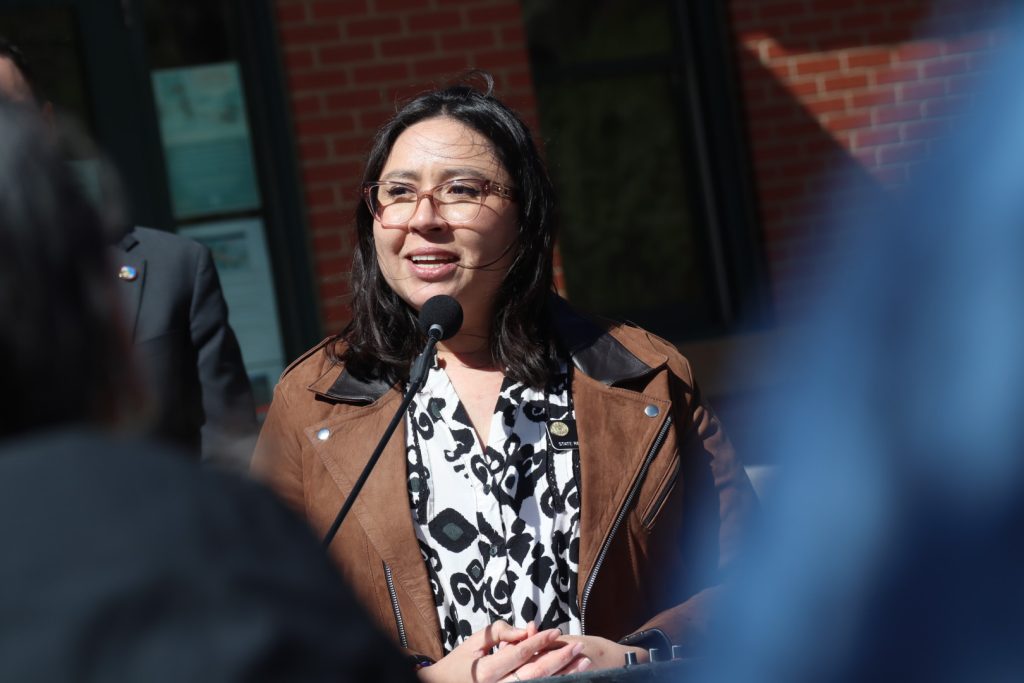
“Currently, we have students who clearly meet the skill level for biliteracy, or bilingualism, but they cannot access recognition simply because their school doesn’t offer it,” Rep. Elizabeth Velasco, a Glenwood Springs Democrat and one of the bill’s primary sponsors, said during the bill’s Feb. 5 Education Committee hearing.
House Bill 1028 would expand access to biliteracy credentials by allowing students in school districts that do not offer the program to still complete it through other department-certified entities, which could include partnering with other school districts.
A biliteracy diploma endorsement is awarded to students who can read, write, speak and understand English and an additional foreign language. Bilingualism endorsements, which would be created under House Bill 1028, would be awarded to students who can speak and understand another language but don’t possess reading and writing skills — sometimes because the language is primarily oral and doesn’t have a standardized written form.
“The reason why (this distinction) is so profoundly important is because … we have many languages that also don’t have written language, and that in itself precludes them from being able to demonstrate and highlight that they are in fact bilingual,” said Rep. Lorena Garcia, an Adams County Democrat and one of the bill’s primary sponsors.
For higher education institutions that recognize the seal of biliteracy and bilingualism in high school diplomas, students with these seals could see them transferred into credits or be placed in a higher-level language class.
The seal would be especially beneficial to students who learned a foreign language outside of a classroom setting, who otherwise wouldn’t receive any credits or recognition for their abilities.
“The kids of immigrants are speaking their native language at home, but they might not have any AP classes or any classes where they’re learning how to write it,” Velasco said.
Jorge Garcia, Board Chairman and CEO of the Colorado Association for Bilingual Education, testified in favor of the bill nine years after supporting the original 2017 legislation. Garcia said the legislation “had a very powerful impact” on thousands of students across the state, some of which received college credit for having the seal and had better access to scholarships.
Expanding access to the seal of biliteracy through third-party organizations, Garcia said, increases these opportunities for students without lowering existing standards or reducing the rigor of these endorsements.
Educators and other community members also asked lawmakers to consider amendments, such as updating how bilingual proficiency is measured and including equivalent credits outside of those acquired through Advancement Placement assessments, which are designed for students planning to attend college.
James Yoder, who helps coordinate a biliteracy program in Aurora, said only two colleges and universities in the state currently recognize these seals. He suggested that language be added to the bill requiring all state colleges to recognize the achievement either through credit, higher-level placement in language classes or another benefit that helps students save on tuition.
“As it stands, the seal of biliteracy is basically a certificate and a pat on the back,” Yoder said.
Despite all 50 states offering the seal of biliteracy, Colorado is one of six states that does not collect data on students that receive the seal. Yoder requested that language be added to the bill that requires the Colorado Department of Education to collect and report that data.
If passed, the bill is projected to cost the state over $36,000 during its first year (2026-27) and $24,000 in the years following, most of which would come from the general fund during an already tight budget year.
Some lawmakers expressed concerns over the bill’s financial costs, pointing to bill language that says school districts that don’t already have their own program would have to pay a fee to work with a college or educational nonprofits.
Rep. Dusty Johnson, representing House District 63, shared that some of her smaller school districts are barely able to keep track of their K-12 costs, and that unintended fees could put them at more of a deficit.
Offering either endorsement program remains optional for school districts, Garcia said. One of the bill’s amendments further clarifies that if a student needs the services of another school district to attain a seal of bilingualism or biliteracy, an agreement has to be made between the school districts.
The bill passed the House Education Committee Thursday with an 8-5 vote and was referred to the Committee on Appropriations.
“I think for many of us immigrants, when we come to the U.S., we are met with a system that sees us as lacking something because we don’t speak English. But we’re actually bringing so much more,” Velasco said, recounting her own experience of arriving in the United States when she was 16 years old. “For me, it’s very very important for students to be able to celebrate … those skills that they have and are bringing from home, or from a different country.”









Support Local Journalism
Support Local Journalism
Readers around Glenwood Springs and Garfield County make the Post Independent’s work possible. Your financial contribution supports our efforts to deliver quality, locally relevant journalism.
Now more than ever, your support is critical to help us keep our community informed about the evolving coronavirus pandemic and the impact it is having locally. Every contribution, however large or small, will make a difference.
Each donation will be used exclusively for the development and creation of increased news coverage.