Colorado educators spotlight rural school challenges as they call for change to TABOR limit
Education leaders rallied outside the Capitol in support of a potential ballot measure that would raise the state’s tax revenue cap and invest more money into K-12 schools

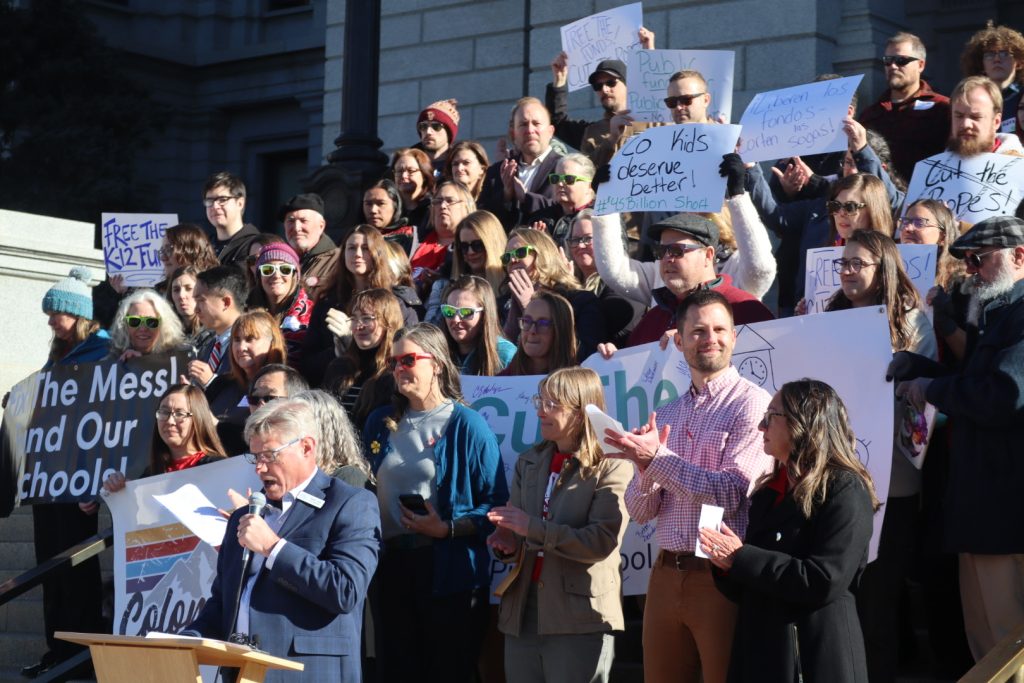
Robert Tann/Post Independent
Teachers and staff from school districts across Colorado rallied outside the Capitol in Denver on Thursday to support a potential ballot measure that would boost funding for K-12 education by hundreds of millions of dollars over the next decade.
The Colorado Education Association, the state’s largest teachers union, is urging lawmakers to refer a ballot measure to voters in November that would raise the state’s revenue cap under the Taxpayer’s Bill of Rights, or TABOR.
TABOR is an amendment to the Colorado Constitution approved by voters in 1992 that prevents state government revenue from increasing beyond the rate of population growth plus inflation. Any revenue the state collects above that cap must be returned to taxpayers, known as TABOR refunds, and the state cannot raise its revenue cap without approval from voters.
Critics argue the cap has choked the state’s education budget and fueled a funding crisis in districts large and small.
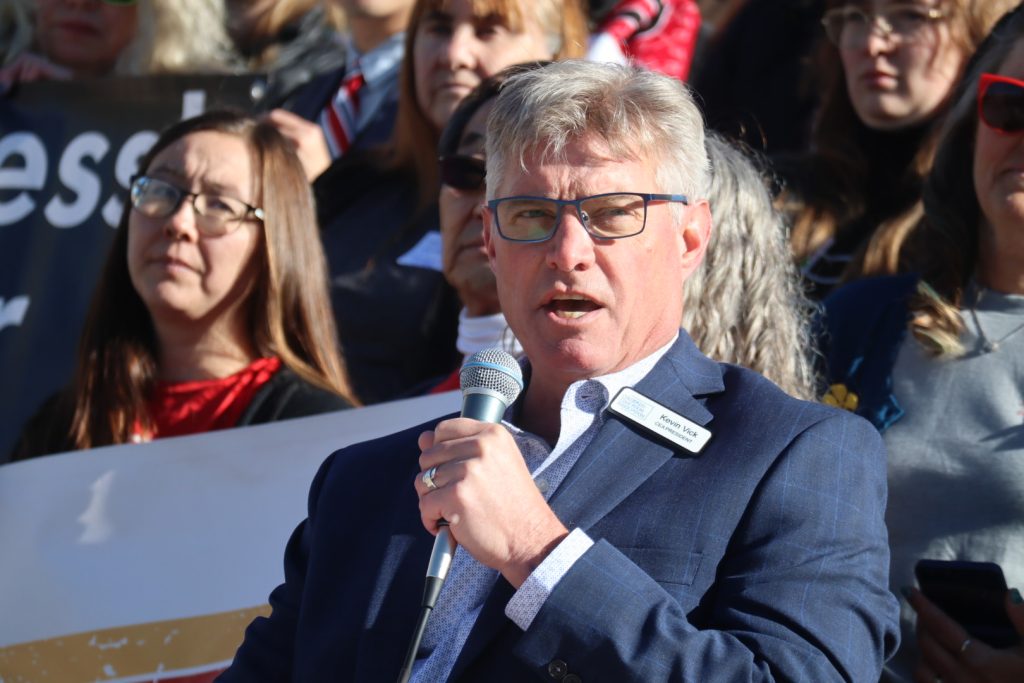
“Educators from every corner of Colorado are coming together with one, clear message to their elected representatives: It’s time to cut the ropes on school funding,” said Colorado Education Association President Kevin Vick, speaking in front of a crowd of teachers and school staff.
“For more than 30 years, an outdated and arbitrary revenue cap has kept our state funding tied up so tightly that we can’t invest in public education and keep up with student needs,” Vick continued. “Even when Colorado’s economy is strong, this cap blocks the state from using money it already collects for K-12 education.”
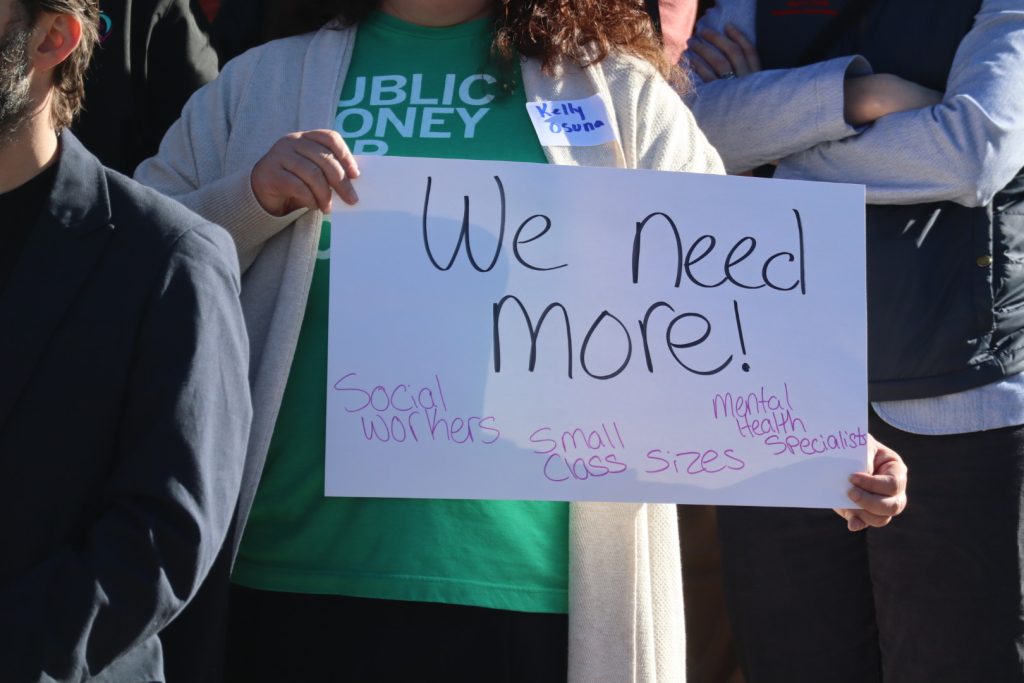
Vick said the state’s funding constraints have an outsized impact on rural districts, which struggle to hire and retain teachers, bus drivers, counselors, and special education staff. In mountain communities, those issues are compounded by a high cost of living and scarcity of affordable housing.
In Steamboat Springs, teachers have been outspoken about the daily struggle of housing insecurity, balancing multiple jobs, and the toll it takes on their mental health. In Aspen, district leaders are racing to build nearly 100 housing units over the next 15 years to meet employee demand. And in Summit County, support staff such as bus drivers, custodians and paraprofessionals are seeking to unionize over better pay and working conditions.
Sam Islaub, a library teacher and paraprofessional at Silverthrone Elementary in Summit County, said during Thursday’s rally that educators “should be able to afford to live in the communities where they work.
“Schools keep losing teachers, paraprofessionals and support staff because wages don’t come close to a livable income,” Islaub continued. “Turnover increases, stability disappears and students lose the trusted adults who support them every day.”
Under the ballot measure being proposed by educators, the state would raise its TABOR cap by the amount of money it spends on K-12 schools through its general fund, which is currently about $4.5 billion.
That doesn’t mean the state would have $4.5 billion more per year to invest, since revenue is based on economic factors and can vary widely, but it would free up additional revenue that would otherwise be refunded to taxpayers.
The education association believes raising the TABOR cap would generate $90 million to $100 million more for K-12 schools per year over the next decade. That would be on top of additional investments in education funding that lawmakers have already committed to.
The legislature in 2024 abolished what they called the budget stabilization factor, a Great Recession-era funding mechanism that allowed Colorado to fund K-12 education below what’s required in the state constitution. Lawmakers also passed a new school finance formula that is set to deliver $500 million in new funding over the next seven years.
Yet even with those investments and a raise to the TABOR cap, educators say schools will still be underfunded in Colorado.
They point to twin studies commissioned by the legislature and released last year that show Colorado would need to increase annual school spending anywhere from $3.5 billion to $4 billion to be sufficiently funded. A 2025 analysis by the National Education Association ranks Colorado 46th in the nation for starting teacher salaries.
“We don’t think this (ballot measure) is the final piece. We don’t think it will fix everything,” Vick said following the rally. “But, we need to provide some relief now and get this increase in funding started so that we’re not losing generations of kids to this crisis situation.”
Democrats, who control both the state House and Senate by wide margins, can refer a ballot measure with only a simple majority vote. While ballot measures that change the Colorado Constitution require support from two-thirds of lawmakers in both chambers, increasing the TABOR cap can be done without a constitutional amendment.
Sen. Jeff Bridges, D-Greenwood Village, who sits on the legislature’s powerful Joint Budget Committee, plans to sponsor a bill to refer the ballot measure. Vick said the bill could be introduced sometime in February.
Unlike legislation, lawmakers don’t need Gov. Jared Polis’ signature to pass the ballot measure. The governor didn’t commit to throwing his support behind the measure when asked about it last week.
Republicans, who remain fiercely defensive of TABOR, are expected to oppose it.
Sen. Barbara Kirkmeyer, R-Brighton, who sits on the budget committee alongside Bridges, has argued that raising the TABOR rate is effectively a tax increase, since it would eliminate TABOR refunds.
Coloradans have shown strong support for keeping refunds, rejecting ballot measures in 2019 and 2023 that would’ve allowed the state to keep that money instead.
Speaking about the potential ballot measure for this year, following a press conference on Jan. 13, Kirkmeyer said, “I know what my campaign would be, ‘You can’t raise the cap because it increases your taxes.'”
Kirkmeyer continued, “And in a time when affordability is the issue, and people are struggling to make ends meet … I just don’t think that will pass.”
Vick said lawmakers should still give educators “the opportunity to make our case to the Colorado voters.”




Support Local Journalism
Support Local Journalism
Readers around Glenwood Springs and Garfield County make the Post Independent’s work possible. Your financial contribution supports our efforts to deliver quality, locally relevant journalism.
Now more than ever, your support is critical to help us keep our community informed about the evolving coronavirus pandemic and the impact it is having locally. Every contribution, however large or small, will make a difference.
Each donation will be used exclusively for the development and creation of increased news coverage.