With discussions on public transportation in western Garfield County ramping up, questions regarding RFTA’s Hogback route raise concerns
Post Independent
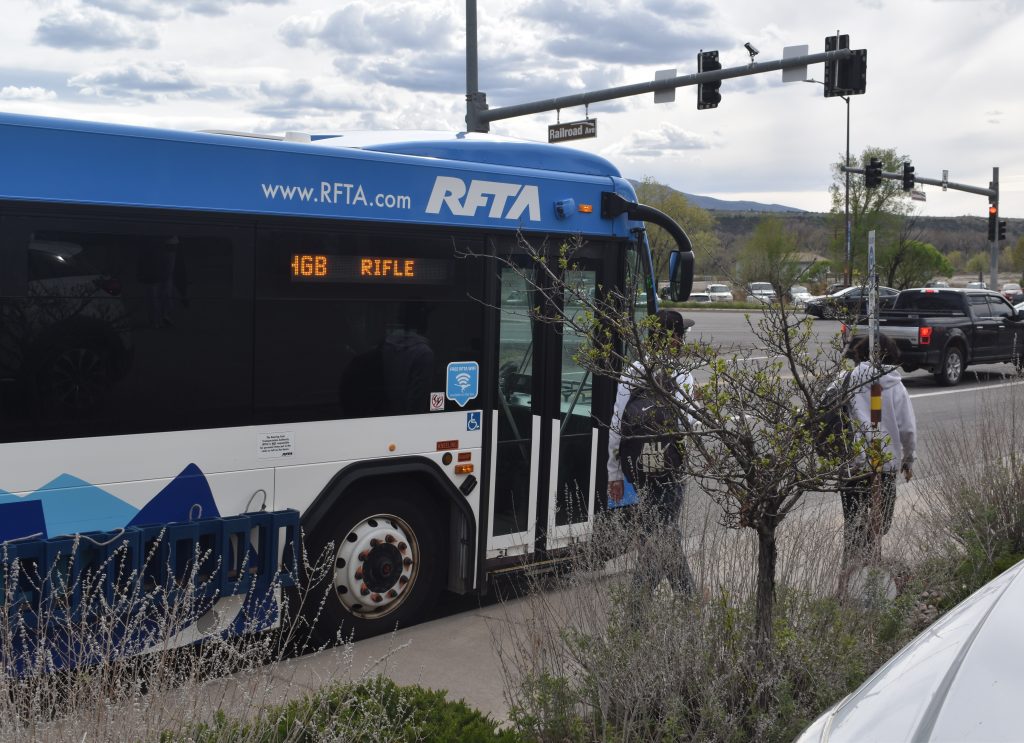
Julianna O’Clair/ Rifle Citizen Telegram
Transportation in western Garfield County has continued to be a topic of concern for community members and officials alike following a pitch made by Silt Town Manager Jim Mann in February to fund the Roaring Fork Transportation Authority’s Hogback route by reallocating funds from the county’s library district.
The Hogback route is one of few public transportation options connecting Glenwood Springs to western Garfield County, with stops in New Castle, Silt and Rifle. Hogback riders can connect with other buses in Glenwood Springs to head towards Aspen, or a Parachute Area Transportation System, PATS, bus in Rifle to travel further west.
How the Hogback route has been funded in the past
Historically, the county has funded the majority of the Hogback route, aided by smaller contributions from RFTA and Rifle. Garfield County commissioners have contributed up to $750,000 a year since 2002, but over the past few years county contributions have dwindled as revenue from oil and gas production have dropped and other expenses continued to rise.
County funding for the Hogback was going to be pulled completely in 2026, but after a push from local officials, commissioners agreed to contribute $250,000, half of the $500,000 granted to the Hogback in 2025. Rifle has been contributing $40,000 to the Hogback service for years and as of the start of 2026, Silt has begun contributing the same amount.
The funding gap left by the county is currently being filled by RFTA, a decision that is costing the transportation district around $407,000.
Hogback service past New Castle, which is a member of RFTA, is scheduled to end on Nov. 22 this year.
Garfield County Commissioner Tom Jankovsky emphasized that the decision to stop funding the Hogback was purely financial.
“We had 35 positions that we didn’t fund for this fiscal year because of the reduction in property taxes, and what we were paying on the Hogback covered four of those,” Jankovsky told the Post Independent. “…I think it’s time to talk about the fact that the Hogback needs to pay for itself.”
Even if a solution is not found before November, county funds for the route will be cut completely in 2027, according to Jankovsky.
Funding solution proposed by Silt Town Manager
Conversations on public transit began in earnest in October during a Rifle City Council meeting when the Western Colorado Alliance, the town of Parachute and the Rifle Senior Center each addressed public transportation concerns with the councilors: the Hogback route, PATS, and the Traveler, which is run by RFTA.
Questions about how the Hogback would be funded were raised at a Rifle City Council meeting in November and discussed at a meeting between Garfield County commissioners and Rifle City Council in February, where Silt Town Manager Jim Mann proposed reallocating funding from the Garfield County Libraries.
Mann suggested reallocating how funds from the county’s 1% sales tax are currently distributed. The county currently retains around 48% for its general operations, while 52% is dedicated to the communications authorities, libraries and a giveback to the municipalities.
Mann’s proposal would cut the amount the library receives to around 14% of the total sales tax revenue, with 11% going to transportation initiatives. Around $1.95 million in funding would be shifted to support the Hogback route west of New Castle, PATS and the Traveler, with the library district losing $1.83 million and the municipality giveback decreasing by $0.12 million.
Other RFTA communities would receive about a $20 per capita rebate for their own transportation initiatives as an incentive to support the measure, according to the proposal. PATS is also poised to lose funding as Garfield County reduces overall contributions to public transportation services, according to Mann.
Silt Mayor Pro-Tem Derek Hanrahan emphasized the urgency of finding a funding solution, pointing out that local leaders have around seven months before the Hogback stops traveling to Silt and Rifle.
“There’s an urgency to the issue that needs to be resolved. The Hogback was supposed to stop earlier, but the mayors of a lot of our local communities, during a mayor’s meeting with the Garfield County Commissioners, asked them to continue funding for 2026 and the commissioners agreed to do so,” Hanrahan told the Post Independent.
“I think it’s important to frame the main problem here: the commission is not planning on funding the bus anymore,” he added. “RFTA is not planning on funding the bus themselves. This proposal is an effort to come up with a way to try and allow the bus to keep running.”
A temporary 1 mill levy approved in 2006 generates around $2.67 million total for the library district annually and is set to sunset in 2027. The library district also has a debt service of $1.67 million, leaving the libraries with around $1 million from the current mill levy. If the mill levy is reupped, the library district would receive funding from it again in 2028, which would be around $2.7 million without debt service, according to Mann.
News you can trust. Straight to your inbox.
Sign up for our morning newsletter: PostIndependent.com/newsletter
Mann believes that if the mill levy is reupped, the library’s funding would take a hit in 2027, but without the debt service, would be restored in 2028 to around 2026 levels even with the property tax redistribution.
Currently, the library district has $9.33 million available for operations — not including reserves — which would decrease to $7.6 million in 2027, which would include use of reserves, Mann stated in a separate email to the Post Independent, and increase to $9.36 million in 2028 with the mill levy, Mann’s proposal states.
Mann pointed out that the Garfield County Library District has around $25 million in reserves, and stated he believes they could cover a funding loss in 2027 without decreasing services.
According to Jamie LaRue, former executive director of the Garfield County Libraries who retired on April 9, Mann’s proposal would reduce library funding by about $400,000 if the library district’s mill levy passes. If the mill levy isn’t reupped, Mann’s proposal would cost the libraries around $3 million a year, 28% of their anticipated annual income in 2027, according to LaRue.
“Let’s face it, if somebody walked in my door and said, oh, by the way, I’m gonna suggest that we take away $1.8 million a year in revenues, I wouldn’t be happy about it, so, number one, that’s some of the backlash you’re going to get,” Mann said when asked why he thinks his idea has caused such a stir.
“Number two, I think there’s a lot of misinformation out there,” he added. “We’re not proposing closing libraries. We’re not proposing changing anything. This is a reallocation of county resources, and I don’t get to do it. I might be able to propose something…but it requires the county board to then put something on the ballot, and it requires the county electors to actually approve it.”
Around 25% of the Hogback funds would come from the reallocation. Silt and Rifle, which currently contribute less than 10% of Hogback funding at $40,000 each, would need to increase their contributions to around 22.5% total — about $90,000 — according to Mann, leaving RFTA to fund around 53%.
For Mann’s solution to work, voters would need to approve two different ballot measures, one to reup the mill levy and one to reallocate county funds.
“I’m happy to answer any questions. I’m not happy to be called unethical. I’m not happy to be told that I’m stealing candy from a baby and ruining people’s lives,” Mann said. “We’ll be ruining people’s lives if we don’t have a bus service too.”
Garfield County Library District responds to proposal
Mann’s idea was received with upheaval from the communities of Silt and Rifle, as well as LaRue and Adrian Rippy-Sheehy, president of the library’s board of trustees.
Rippy-Sheehy explained that in 2026, the library already took a $850,000 cut due to a decrease in 2025 oil and gas evaluations. The $25 million in the library’s reserves has already been earmarked for various expenses, including upcoming refreshes of the Silt, Rifle and Carbondale libraries.
The library is also required to keep 100% of the year’s prior expenses in reserves at all times, which is about $12 million, and 3%, or around $145,000, for emergency reserves, according to Rippy-Sheehy.
When she heard the proposal, “I was flabbergasted. In fact, I remember laughing and going ‘You have got to be kidding me,'” Rippy-Sheehy said. “Just because we have been frugal and saved up money and have reserves — when we had those couple good years with the oil and gas we saved it and anticipated our future.”
LaRue spoke at the Rifle City Council public comment on March 4, stating that the Garfield County Libraries were unaware of the possible proposal before hearing about it on Feb. 12. LaRue said he considers this proposal, if it were to pass, to be “highway robbery,” and that he would be recommending to the Library Board of Trustees to pause all construction projects for the Silt and Rifle Libraries.
The Garfield County Libraries has extra money in the bank, almost double their savings, but LaRue stressed this was not their usual fare. The library district’s $12 million in reserves are not unlike the city of Rifle’s roughly $10 million in reserves due to a conservative spending budget.
LaRue shared his thoughts on the suggestion after some time had passed.
“I’m not sure I’ve reached a consensus and it’s not the responsibility of the Libraries to pay for public transit,” LaRue said. “I called him when I first heard about it and he told me he’d come up with a scheme. He doesn’t understand our finances because he never asked, and Silt Town Council expressed that they thought it wouldn’t hurt the Libraries.”
LaRue asked why the county couldn’t step up to come up with a better solution.
“75% of mass transit goes upvalley. To Aspen, to Glenwood Springs, this is their problem too,” LaRue said. “It strikes me as laziness, this proposal, as punishing people for planning ahead, and we invest money into our communities.”
LaRue remembered a proposed project between the Libraries and Town of Silt that would benefit the Silt Police and the Libraries.
“I spoke to Mann about a joint project that would involve bringing the Silt Library and the Silt Police together in a construction project,” LaRue said. “I said, of course, we’d support it. We didn’t hear anything more about it, but we’re investing in our communities, we want to support our communities, and we run the Libraries with community centered librarianship.”
LaRue said he wants the Garfield County Libraries to know about issues and how they can help contribute to solving them.
“How can we help if we didn’t know about it?” LaRue said, referring to Mann’s proposed ballot measure. “When it seemed like this proposal was likely to go forward, I suggested to the Library Board of Trustees to not continue our planned construction projects for the Rifle and Silt Libraries, because that money comes from our reserves, but if the Libraries were to lose that money, we would have to pull it to defend ourselves.”
The projects include quality of life improvements to libraries throughout municipalities across Garfield County, including Parachute, New Castle, Rifle and Silt. At LaRue’s final board meeting before his retirement, he said he would retract his suggestion to not proceed with the construction of the Silt and Rifle Libraries.
“Libraries are to let people know they’re not alone,” LaRue said. “That the possibility of the human story is alive and well, and making it available to everyone is for the best. I truly believe that with all my heart.”
The search for other solutions
A team dedicated to coming up with a solution for transportation in western Garfield County, called the Colorado River Valley Transit Solutions, was put together with help from Alicia Gresley, director of the Colorado River Valley Economic Development Partnership, last year.
“The group came about last April and we’ve been talking about transit for some time,” Gresley said. “The challenge of the Hogback was there as well, and the county wants out because they didn’t want to fund it long-term. It was never supposed to be a long-term thing.”
Gresley said the solution to fund the Hogback route is part of a greater need to fund transit structure in general.
“We keep doing the same thing over and over and getting the same solutions,” Gresley said. “The group is really functional but it’s going to take time, because we need to gather information to present to the municipalities.”
The point of the group isn’t to be political, Gresley said, but to find pragmatic and long-term solutions.
“There’s a couple of potential pathways, and one of them could involve Rifle and Silt putting RFTA back on the ballot, but I don’t see that happening this year,” Gresley said. “Putting it back on the ballot costs money and polls and the CRVTS doesn’t have that money, and we’re not there yet to suggest that from the information we’ve gathered so far.”
The CRVTS is in a “weird middle zone” as Gresley put it, where they are not in a place to suggest anything concrete at the moment as they gather more information with help from RFTA, stakeholders, the Western Colorado Alliance and a recent survey conducted in October.
“In reality, funding the Hogback and more public transit is probably going to be a combined public and creative method that hasn’t been done before and we’re going to have to think outside the box a little bit,” Gresley said. “Everyone’s trying to do what’s best because one municipality can’t just fund it and our populations have evolved since the last RFTA vote.”
If Silt and Rifle were to join RFTA as member jurisdictions, the Hogback route could continue to run at its existing service levels. However, this would require voters to approve a 2.65 mill levy and another sales tax in Rifle and Silt. In an election around 20 years ago, Silt and Rifle voters rejected a proposal to join RFTA.
Mann believes that voters wouldn’t approve an increase in taxes if the proposal was put on the ballot again this year.
“This is just a compromise of ‘how do you convince the county to fund these things without necessarily impacting any of the taxpayers?'” Mann said. “I’d rather do it without raising taxes than trying to put a question out there to raise taxes, because I think raising taxes in this environment is not going to be easy.”
Hanrahan agrees with Mann.
“I think given the current economic environment, with a lot of other costs of living going up, I think the chance of a ballot initiative to generate the new tax is unlikely to pass,” he said. “I also feel like it’s, in some ways, advantageous to the community to find a way to reallocate some of the existing funding, such that we can assure all services…transportation, the library, all the other stuff that the county funds.
“This proposal allows all of those things to stay solvent, and it does so without raising any new taxes,” he added.
However, a 2025 Colorado River transportation needs assessment survey by Western Colorado Alliance suggests that Silt and Rifle citizens might approve a tax increase. Out of 376 responses, around 73% of the Rifle residents and around 81% of Silt residents indicated they would approve a 0.5 cent sales tax increase to fund increased bus service in their area.
“I”m a citizen of Silt and I haven’t been asked in 20 years whether I’d like to participate in RFTA, and I would,” Rippy-Sheehy said. “I wouldn’t mind having that sales tax increase for my residency there. It was just outrageous to say, well let’s just take it from the library when it doesn’t have anything to do with transportation and really would put us at a great disadvantage.”
Pitkin County Commissioner and Board Chair of RFTA Greg Poschman stated that he believes the funding solution proposed by Mann is like “robbing Peter to pay Paul. They need the library funds, so taking it from one fund and putting it into another one just creates a deficit somewhere else,” he said.
Poschman also recognizes the importance of the Hogback route, even though the bus doesn’t pass Glenwood Springs. He called it an “essential service,” noting its importance for downvalley residents who are employed in Aspen.
“We have a huge tourism industry, which drives a lot of work for a lot of people who commute up valley and then take their paychecks back and spend them in the counties and communities farther down the valley,” Poschman told the Post Independent. “So, they’re an essential part of our community, and I think our community must be considered something like 100,000 people now if you stretch all the way down that valley.
“It’s good to think of it that way, because when we’re making decisions on just how important is the hogback service, that helps the conversation,” he added.
When asked if Pitkin County might help fund the Hogback, Poschman explained that although the county has a higher cash flow, difficult budget conversations are happening in communities like Aspen, too.
‘”Pitkin County has put a lot of money into RFTA since it started up here,” Poschman said. “Pitkin County is probably the largest funder of RFTA already, and we have budget shortfalls with the loss of federal and state fundings. We’re in a tight spot, like everyone else.
“We have a higher cash flow, but we’re going through difficult budget conversations,” he added. “Garfield County could come to us and ask us for help, I suppose…but I guess the answer is, there’s no easy money, but all options are on the table.”
RFTA’s role
RFTA has also been a part of the conversation surrounding the Hogback route and public transit in Garfield County as a whole. RFTA CEO Kurt Ravenschlag was asked about the organization’s current stance on the situation.
“RFTA has actively been engaged in the Hogback funding conversation and over the past several months, we’ve met with Garfield County Commissioners, Rifle City Council, the Silt Town Board and participated in the Colorado River Valley Transportation Forum,” Ravenschlag wrote in an email. “These discussions are aimed at finding a collaborative solution to the long-standing funding gap that threatens the Hogback service between New Castle and Rifle. RFTA’s goal has been to work with regional partners to explore sustainable options for keeping this service running.”
Ravenschlag wrote that RFTA is playing a supportive role, supplying information regarding viable and nonviable options, what it would look like to join RFTA as a member jurisdiction, and technical information.
“The Hogback service operates between Glenwood Springs and the towns of New Castle, Silt, and Rifle,” Ravenschlag wrote in an email. “To date, Garfield County historically has been the primary funder of the segment between Rifle and New Castle, and has been covering most of the cost, although their contributions have gradually decreased over the past five years.”
Ravenschlag said that rising post-pandemic operating costs combined with Garfield County’s decision to not provide further funding beyond 2026 creates a gap that RFTA can’t cover on its own.
“The town of Silt, city of Rifle, and Garfield County are not RFTA members, which complicates long-term funding stability,” Ravenschlag wrote in an email. “Continuing the service past November 2026 will require new regional funding solutions or potential RFTA membership by these communities. The Hogback service between Glenwood Springs and New Castle will continue because they’re both members of RFTA.”
Ravenschlag wrote that RFTA, Garfield County, the city of Rifle, and the town of Silt are collaborating to identify sustainable funding solutions to maintain service to Silt and Rifle.
“RFTA believes reliable transportation in Western Garfield County is essential for connecting communities like Silt and Rifle to Glenwood Springs and beyond for work, school, healthcare, and recreation,” Ravenschlag wrote in an email. “RFTA emphasizes that sustainable transit in this area depends on collaboration between local governments, Garfield County, and RFTA to ensure long-term service stability, particularly given the current funding challenge with the Hogback route.”
Ravenschlag emphasized the benefits of connecting the municipalities of Garfield County.
“There is benefit to both RFTA and its member jurisdictions in having these communities connected to the larger system,” he wrote in an email. “RFTA is open to being a financial partner if all parties come together as equitable partners.”
If Mann’s proposal moves forward, representatives from Silt will appear before the Garfield County commissioners this summer to discuss placing the issue on the November 2026 municipal ballot.


Support Local Journalism
Support Local Journalism
Readers around Glenwood Springs and Garfield County make the Post Independent’s work possible. Your financial contribution supports our efforts to deliver quality, locally relevant journalism.
Now more than ever, your support is critical to help us keep our community informed about the evolving coronavirus pandemic and the impact it is having locally. Every contribution, however large or small, will make a difference.
Each donation will be used exclusively for the development and creation of increased news coverage.