Garfield County leaders discuss shifting library funds to western Garfield County transit
County commissioners meet with Rifle City Council and Silt town manager to discuss transit funding options

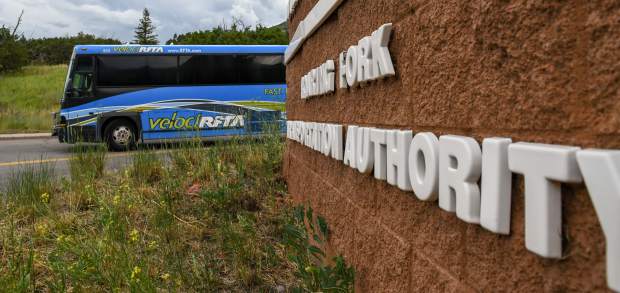
Post Independent File photo
The Garfield County Board of County Commissioners and Rifle City Council, joined by Silt Town Manager Jimm Mann, met on Wednesday night for their annual collaboration meeting to discuss several issues, including public transportation between Glenwood Springs and Rifle and a potential ballot measure that could redirect some library funding to transit.
The Roaring Fork Transportation Authority operates bus routes from Aspen to Glenwood Springs and communities in between. West of Glenwood Springs, however, RFTA operates only one line to Rifle — the Hogback line.
Rifle is contributing $80,000 this year to help sustain the Hogback, and for the first time, the town of Silt is contributing $40,000 to ensure the line’s lifespan. The Garfield County commissioners initially pulled all funding for 2026 but later decided during a mayor’s meeting in October to contribute $250,000 to the route.
Transportation has been a recurring topic for western Garfield County communities. In October, surveys conducted by the Western Colorado Alliance gathered feedback on transportation needs in the Roaring Fork Valley and were presented to Rifle City Council. During that meeting, Parachute Town Manager Travis Elliott also provided an update on the Parachute Area Transit System, or PATS, which is partially funded by Rifle, while Rifle Senior Center Director Tami Sours shared feedback from seniors who use RFTA’s Traveler service.
When RFTA updated Rifle on the Hogback line, officials noted the agency had been covering an annual shortfall of about $200,000 from Garfield County for several years. Rifle officials have voiced frustration with the city’s role in funding the route and what they see as an imbalance in who benefits.
“The same questions, the same proposal keeps coming back year after year after year,” Councilor Alicia Gresley said during theNov. 6 meeting. “What you’re doing is you’re taking our people out of our communities and taking them up to other communities…Why is the burden placed on the people of Rifle in order to support the economy upvalley?”
During Wednesday’s meeting, Mann presented a possible idea for funding the Hogback line.
“Right now, the bus (Hogback Line) runs up and down Highway 6, goes up north into Rifle a little bit, but it doesn’t necessarily get people to where they need to be,” Mann said. “I’m talking about the retail hub south of the interstate, I’m talking about CMC (Colorado Mountain College), I’m talking about Walmart, Grand River Hospital, those are the places people need to get to.”
Mann also noted that until recently, there was no midday service on the Hogback line, meaning riders traveling in the morning often had to wait until late afternoon for a return trip.
Mann recounted that the county has a 1% sales tax, which is allocated in various ways: the county receives around 48% for its general operations, and 52% to the communications authority, libraries, and a giveback to the municipalities.
The libraries receive around 50% of the 52%, which Mann said was around $4.6 million.
“If you were to take half that contribution to the library and focused it on transportation issues for the county, you could fund the Traveler, you could fund part of the Hogback, and you could fund PATS,” Mann said.
Garfield County Commissioner Chair Tom Jankovsky, described the county’s prior contributions to the Hogback bus line.
“Since 2002, we’ve subsidized the Hogback for $750,000 a year, and for the last five years, we’ve started cutting back, we were at half a million for a couple years, and this year, we’re at $250,000,” Jankovsky said. “We’re in a situation, not only with the Hogback, and we subsidize PATS for $250,000, and the Traveler, we’re carrying more than our share on the Traveler again.”
Jankovsky said “they have put RFTA on notice.”
“We need to come up with some funding for that (Hogback line) and you guys (Rifle) don’t need to come up with funding…hopefully you don’t need to take out money from your general funding for that,” Jankovsky said.
When Rifle Mayor Clint Hostettler asked for clarification, Jankovsky said the county is considering stepping away from funding the route if a long-term solution is not found.
“We’re telling them we’re not going to fund them anymore,” Jankovsky said. “I know how much chaos it would create with that bus not running, but the system’s got to be fixed and not on the back burner.”
Hostettler said Garfield County must be part of any solution, noting that Silt and Rifle cannot shoulder the burden alone even if Parachute joins the effort.
Mann is hopeful that his rough concept might be able to help transportation in western Garfield County.
“I know for a fact that Glenwood Springs does not want the Hogback to go away, because everyone going east is going to be driving,” Mann said. “If I’m leaving Silt, I’m not stopping in New Castle and getting on a bus there, I’m driving all the way, I’m already in my car.”
Mann also referenced the Garfield County Libraries’ funding structure, including a temporary 1-mill levy that sunsets in 2026 and generates about $2.6 million annually, as well as a permanent 1.5-mill levy.
“So if we’re removing $2 million from the library, but they can go to the voters and say, without raising taxes, re-up our 1 mill levy, which was originally for capital, let’s say it’s for capital and operations, the library still has $600,000 annual capital fund that’s coming back to them,” Mann said. “It solves part of our problem, it solves some of the budgetary issues that the county is dealing with, but requires Silt and Rifle to put more skin in the game.”
For this plan to work, it would require two ballot measures, one for the libraries mill levy re-up and one for reallocation of resources. Both would need to pass for the plan to work.
“When this mechanism (county sales tax going back to the Libraries) was put in place, in 1997, it was the only funding the Library had,” Mann said. “Now they have their own mill levy.”
The concept remains in its early discussion stages, and Garfield County Libraries officials said they were unaware of the proposal until recently. The idea was first presented during a Feb. 4 Rifle City Council work session and then discussed at the joint meeting with county commissioners on Wednesday. Feb. 11.
Garfield County Executive Director Jamie LaRue said he had not heard of the proposal until Thursday.





Support Local Journalism
Support Local Journalism
Readers around Glenwood Springs and Garfield County make the Post Independent’s work possible. Your financial contribution supports our efforts to deliver quality, locally relevant journalism.
Now more than ever, your support is critical to help us keep our community informed about the evolving coronavirus pandemic and the impact it is having locally. Every contribution, however large or small, will make a difference.
Each donation will be used exclusively for the development and creation of increased news coverage.