Colorado agencies call for removal of Roan Plateau parcels from federal oil and gas lease sale
The Bureau of Land Management has proposed leasing four parcels on top of the Roan Plateau, which advocates have long fought to keep free from energy development

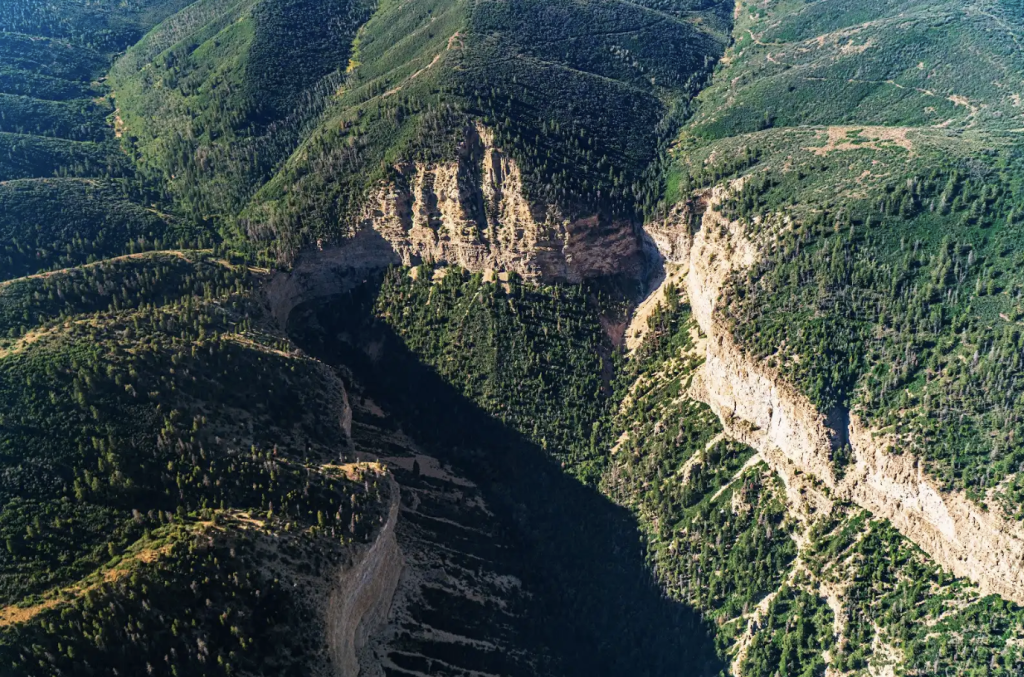
EcoFlight/Courtesy Photo
Two Colorado agencies are asking the Bureau of Land Management to reconsider offering several parcels — including several atop the Roan Plateau — for oil and gas leasing in December, citing concerns about potential impacts on wildlife and water quality.
The Bureau of Land Management has proposed leasing 114 parcels for oil and gas development during its fourth-quarter sale in December. The parcels cover 126,744 acres in Garfield, Rio Blanco, Gunnison, Weld, Arapahoe, Archuleta, La Plata and Las Animas counties.
In separate letters submitted during the sale’s public comment period, the Colorado Department of Natural Resources and Colorado Parks and Wildlife have asked the agency to defer or conduct further consultation on the inclusion of several parcels that overlap with big game habitat and production areas, the Beatty Canyon Ranch State Habitat Area in Las Animas County and the Roan Plateau outside of Rifle.
“The [Colorado Department of Natural Resources] is focusing on improving biodiversity, ecosystem resiliency, and impact reduction,” wrote Dan Gibbs, the department’s executive director. “Therefore, it is vital to the state that the BLM considers impacts to wildlife, people, and the environment as they continue to develop this proposal. Colorado is committed to continuing to be a leading source of energy for the nation while reducing adverse impacts from energy development.”
While the BLM is required to hold quarterly lease sales when eligible lands are available for leasing under the 1920 Mineral Leasing Act, the Trump administration has seen a sharp spike in parcels offered as it aims to execute on the president’s day one order to “Unleash American Energy.” The order seeks to achieve energy independence, increase affordability and provide jobs by reducing red tape and reopening public lands for development.
The 114 parcels being considered for sale in December are among 403 parcels the federal agency has offered for sale in Colorado this year — a large jump from 290 leased in the previous seven years.
The Roan Plateau
Both letters express concerns over the inclusion of several parcels on or near the Roan Plateau in the December sale — an area that advocates have long fought to keep away from oil and gas development.
The BLM first proposed leasing on the 73,600-acre Roan Plateau in 2007 — spurring thousands of protests and a lawsuit that took until 2014 to settle, resulting in the cancellation of 17 leases on the plateau and the creation of a specific BLM management plan for the area. The concerns then — and now — center around how development on the plateau would impact watersheds that support a rare, genetically pure trout species, wildlife habitat that’s crucial to elk, mule deer and greater sage grouse and well-established hunting, fishing and backcountry recreation.
December’s sale could include four parcels located on the plateau and two parcels being offered nearby. In a previous statement, Levi Spellman, a spokesperson for the Bureau of Land Management, said the Roan parcels were included in the sale because they were nominated through an expression of interest on the National Fluid Lease Sale System website. Interest in the six parcels on or near the plateau was submitted by Elevation Resources, LLC, a Denver-based oil and gas brokerage firm.
“They are available for consideration because they are open for fluid mineral leasing under the applicable resource management plan and all applicable legal settlements,” Spellman said.
Gibbs wrote in the letter that the state department of natural resources “has a long history of working to limit oil and gas development on top of the Roan Plateau and we continue to believe that energy development should be minimized across this unique landscape.”
“We still maintain that the Roan contains valuable aquatic and terrestrial natural resources that require thoughtful and robust protections,” Gibbs added.
One new concern, according to Gibbs, is that the Colorado Water Quality Control Commission designated East Fork Parachute Creek — which flows across the plateau — as “Outstanding Waters” in 2024, the “highest level of protection under Colorado’s antidegradation rule.”
The protection was added to protect “hanging gardens, rare forest communities and conservation populations of cutthroat trout in a pristine backcountry setting,” according to the designation.
Gibbs requests that the BLM defer the four parcels on top of the Roan Plateau until adequate analysis under the National Environmental Policy Act is conducted to address how the creek would be protected.
Colorado Parks and Wildlife Director Laura Clellan wrote in a separate letter that additional planning was needed to “strengthen protections for the parcels on top of the Roan Plateau” from energy development. It requested that the BLM defer offering leases there until the effort was conducted.
The concerns include how oil and gas development would impact rare plant species and the “genetically unique” and pure Uncompahgre Colorado River Cutthroat Trout, which have been supported by a decade of reclamation efforts in the Roan’s watersheds.
Clellan added that the parcels overlap with an important production area for the Yellow Creek elk herd “where calf-to-cow ratios have been declining,” a sign of population drops.
“This decline is likely driven by degraded habitat conditions, habitat fragmentation and increasing recreational activity,” Clellan wrote. “The parcels at top of the Roan Plateau are in good elk habitat condition, have minimal fragmentation and do not experience excessive recreation pressures found elsewhere in this elk herd’s range.”
Big game concerns and conservation easements

The letter from Parks and Wildlife also raises concerns with several other parcels contemplated for the December sale.
This includes 10 parcels that overlap with the Beatty Canyon Ranch State Habitat Area in southwest Colorado near the town of Kim. Colorado Open Lands has held a conservation easement on the 13,920 acre property since 2008, secured in part due to Parks and Wildlife’s wildlife habitat grant program.
Parks and Wildlife leveled similar concerns with the BLM’s third quarter sale, as it included the leasing of several parcels overlapping with conservation easements meant to protect wildlife in Moffat and Rio Blanco counties. The BLM denied the state wildlife agency’s protest, claiming that “conservation easements do not preclude oil and gas development when the subsurface mineral rights are severed from the surface ownership.”
It adds that leasing itself does not authorize drilling, and further review of impacts is required during the process for companies to acquire drilling permits.
While Clellan acknowledged the BLM’s take on these easements in her latest letter, she requested that the federal agency consult further with Colorado Open Lands to “help protect the natural resource values this easement was created to safeguard.”
Parks and Wildlife also wants the Bureau of Land Management to ensure that six other parcels — including two on or near the Roan Plateau — comply with adequate protections for big game migration corridors, production areas and winter ranges for bighorn sheep, greater sage grouse, elk, mule deer and pronghorn.
Clellan said that, while the BLM did apply a management plan — the Big Game Habitat Conservation for Oil and Gas Management in Colorado — to many of the proposed parcels, the federal agency did not apply the appropriate stipulations to all relevant parcels. This plan was adopted by the BLM in 2024 to align its resource management plans with state wildlife rules.
Clellan asked that the BLM apply requirements from this plan regarding migration corridors and density requirements for Colorado big game wildlife species.









Support Local Journalism
Support Local Journalism
Readers around Glenwood Springs and Garfield County make the Post Independent’s work possible. Your financial contribution supports our efforts to deliver quality, locally relevant journalism.
Now more than ever, your support is critical to help us keep our community informed about the evolving coronavirus pandemic and the impact it is having locally. Every contribution, however large or small, will make a difference.
Each donation will be used exclusively for the development and creation of increased news coverage.