Colorado lawmakers approve plan to lower home insurance premiums with subsidies for hail-resistant roofs
Bill is modeled after similar legislation that died last year

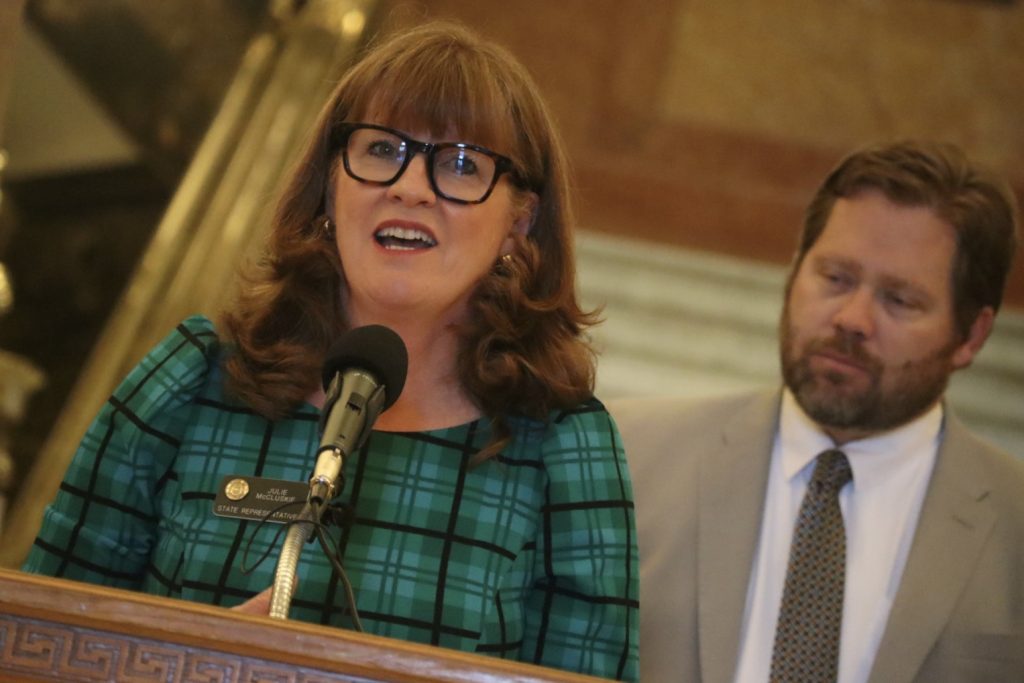
Robert Tann/Post Independent
Colorado lawmakers have succeeded in passing a plan to drive down homeowners insurance premiums by subsidizing hail-resistant roofs, after a similar measure failed at the Capitol last year.
Senate Bill 155 was a top priority for House Speaker Julie McCluskie, D-Dillon, who tried and failed to pass a bill last legislative session to fund programs aimed at alleviating the cost impacts of hail and wildfire on homeowners insurance plans.
This year’s bill represents a slimmed down approach and primarily targets hail relief. The bill would impose a 0.5% fee on every plan written by homeowners insurance companies, with the money collected going to a new grant program that helps homeowners pay for the installation of hail-resistant roofs.
Lawmakers expect the fee will generate up to $100 million in the program’s first five years.
“We’ve been able to craft a bill that will provide relief for our homeowners and hopefully stabilize the market, further promoting a better way to ensure that property insurance rates do not continue to rise,” McCluskie, who is a lead sponsor of the bill, said May 11 during a debate on the House floor.
Colorado’s home insurance rates have surged, driven partly by costlier and more extreme weather events fueled by climate change. Average premiums more than doubled between 2018 and 2023, and Colorado ranks as the sixth-costliest state for homeowners insurance, according to a Colorado State University report.
Costs have been especially high in mountain towns, where some local officials have reported premiums increasing by as much as 1,000% in recent years.
While wildfire risk has been a factor, a recent study by the Colorado Division of Insurance found that hail is the single-largest driver of premium increases. The study showed that hail can account for anywhere from 26% to 54% of a premium’s costs, while wildfire accounts for as little as 0.9% to 24.6%.
Those costs are felt by homeowners across the state, even in places where hail is less frequent. Lawmakers hope that by incentivizing homeowners to do hail mitigation work, it will decrease the risk pool and, in turn, lower premiums statewide.
While this year’s bill does not fund wildfire measures the way last year’s measure proposed — lawmakers wanted to create a reinsurance program to help offset insurers’ losses from catastrophic fires — it would commission a study to look into creating such a program.
Lawmakers also made a key change to the bill’s funding structure to avoid the issue that doomed last year’s bill, which also sought to generate funding by imposing a fee on the plans that insurance carriers write.
One of the Democrats who voted last year to kill the measure, Sen. Kyle Mullica, D-Thornton, argued that the fee would be passed onto homeowners, which was antithetical to the bill’s goal of lowering costs.
This year’s measure includes language that explicitly prohibits insurance carriers from passing that fee onto policyholders as a surcharge.
Mullica said that change was enough to assuage his concerns, and he was a lead sponsor alongside McCluskie of this year’s bill. Other lead bill sponsors were Sen. Janice Marchman, D-Loveland, and Rep. Kyle Brown, D-Louisville.
The measure also secured support from the Rocky Mountain Insurance Association, an industry trade group representing home insurance companies in Colorado, Wyoming, Utah and New Mexico. The group’s executive director, Carole Walker, said in April when the bill was introduced that the industry supported paying the fee because protecting against hail damage would ultimately reduce insurers’ liability.
Republicans, who opposed the bill, were skeptical that insurers would be unable to find a way to pass the fee onto homeowners.
“What they will do is it goes across the board for expenses,” said Rep. Anthony Hartsook, R-Parker. “Businesses incur expenses for everything that they do. This is going to be another expense that is spread across all policyholders.”
The bill ultimately passed both chambers of the legislature along party lines, clearing its final vote on May 13, the last day of the session. The measure now heads to Gov. Jared Polis, who is expected to sign it.








Support Local Journalism
Support Local Journalism
Readers around Glenwood Springs and Garfield County make the Post Independent’s work possible. Your financial contribution supports our efforts to deliver quality, locally relevant journalism.
Now more than ever, your support is critical to help us keep our community informed about the evolving coronavirus pandemic and the impact it is having locally. Every contribution, however large or small, will make a difference.
Each donation will be used exclusively for the development and creation of increased news coverage.