The feds want to help pay Colorado River users to cut back on water, but Colorado wants assurances this water isn’t for Lower Basin states
The state is pushing back launching a program that will pay water users who voluntarily cut back, eliminating the ability for irrigation projects to be considered in year one

Ali Longwell/Post Independent
At the request of the federal government, the state of Colorado has begun designing a program to compensate water users that voluntarily cut back.
The state, however, has decided it won’t move forward with launching the program until it has assurance from the U.S. Bureau of Reclamation that water conserved in the state won’t just be released downstream to Lower Basin users — even if it means agricultural producers won’t be able to participate in the program’s first year.
“Water users really need an opportunity, if they’re doing projects that are timed to the irrigation season, to make decisions about their operations,” said Amy Ostdiek, chief of the Colorado Water Conservation Board’s interstate, federal and water information section, at its Nov. 18 meeting. “… We are very, very late in the year at this point, that it would be really challenging for a lot of agricultural water users, producers to consider enrolling at this point without this certainty.”
This could dull the effectiveness of the program despite the state’s insistence that conservation be spread across water users, as agricultural water consumption accounts for nearly 90% of Colorado’s water use, according to the Colorado Water Plan.
Colorado’s near-term water ‘contribution’ program
The Bureau of Reclamation granted $100 million to the Upper Colorado River Commission in April to support a conservation and contribution program in the Upper Basin states of Colorado, Wyoming, New Mexico and Utah from 2027-2031. Colorado will have access to 51.75% of these funds.
The commission said in a May letter the states have a goal to reduce use by 100,000 acre of water by 2028.
In September, the Colorado Water Conservation Board approved guidelines for its program — which it is calling the 2027 Near-Term Contribution Program — including identifying the project selection criteria.
Referring to it as a “contribution” program — as compared to previous pilots and research that used terms like “demand management” and “system conservation” to describe a similar concept — is intentional, according to an August webinar hosted by the board.
In the webinar, Ostdiek said the primary reason is “it’s intended to be broader in scope than just conservation.”
“A lot of people think about system conservation pilot program or conserve consumptive use programs, as simply fallowing fields, but we really want this to include all water use sectors and water use sectors other than just agricultural uses,” she said. “… The baseline metric for eligibility among the upper division states participating in a contribution program is that water would be voluntarily contributed, that would not be available but for that approved project.”
Spreading out the responsibility of saving water has also been a sticking point for Western Slope stakeholders who want to see the program incentivize proportional participation across the state.
Amy Moyer, chief of strategy for the Colorado River District, said in an Oct. 20 interview that the Western Slope entity supports conservation and contribution programs due to the gravity of concerns facing the river system but that “these programs must be operated in a way that doesn’t have long term or irreversible impact to communities.”
“One of our greatest concerns is that the Colorado River is truly a river of statewide importance, and water from this river really reaches nearly all four corners of our state — and so participation in any future program needs to reflect that use across our state,” Moyer said. “We’ve seen that the west slope has led the way in creative solutions, but we also can’t share this burden alone.”
She added that the River District hopes these programs in the future can focus on ensuring that “the entire state, and namely the Front Range, participate in programs and participate in solutions that help the river in the system as a whole.”
In the project criteria approved by the Colorado board in September, considerations were made to encourage statewide, cross-sector participation and to disincentivize multi-year fallowing projects, where agriculture producers forgo planting crops to reduce water use.
The hold-up in rolling out the program
While the state is ready to accept applications, it has decided it won’t just yet, waiting for assurance from the Bureau of Reclamation of what officials are calling “operational neutrality” — meaning that any water saved through the funded projects not be considered as part of the bucket of water that can be released to or used by the Lower Colorado River Basin states of California, Arizona and Nevada.
Colorado and the Upper Basin states are advocating instead for this amount to be credited to the state conserving it.
In a Nov. 10 letter from Bureau of Reclamation Assistant Secretary Andrea Travnicek to the Executive Director of the Upper Colorado River Commission, the federal agency said any agreements of credits and operational neutrality requires “a larger Seven Basin State conversation.”
“There is currently no water within the Colorado River Basin that is considered operationally neutral,” Travnicek writes. “Until such agreements are made, reservoir operations will continue to be based upon the physical elevations.”
At its Wednesday meeting, the Colorado Water Conservation Board directed staff to continue negotiations with the Upper Basin states and the Bureau of Reclamation to gain clarity on this issue.
Delaying the launch does close the door on the program funding agricultural projects tied to the 2027 irrigation season due to timing concerns. However, Ostdiek said that “there was also a lot of excitement about other types of projects that might provide some operational resiliency for water users, that might provide more opportunities for water users to participate in the future in a program like this and provide them some benefits in the meantime.”
Moyer with the Colorado River District said in October that the Western Slope entity sees water system infrastructure improvements — particularly to aging systems — as an area prime for investment in these conservation programs.
“Those improvements can be important building blocks to looking at creative opportunities for conservation in the future but also important improvements to help us be more drought resilient into the future,” she said. “… It can increase our efficiency and how we use water in our system that in turn allows us to be more creative, be more flexible to look at additional conservation in the future.”
Why operational neutrality matters
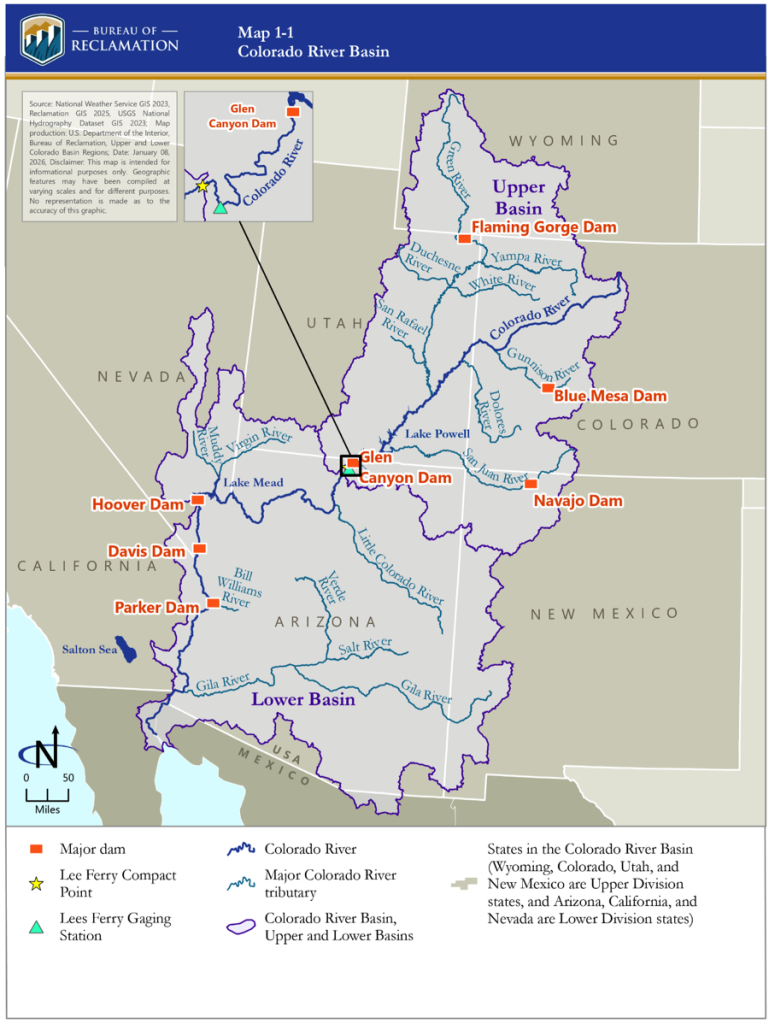
Colorado officials say this need for an operationally neutral credit is driven by the Colorado River basin’s natural hydrology. The Upper Basin states rely predominantly on snowpack for their water supply, while the Lower Basin states rely on releases from Lake Powell and Lake Mead.
“When we say we’re saving for the system and it ultimately goes to the Lower Basin at some point in time — maybe not the point in time that they want it, but at some point in time, it gets there,” said Becky Mitchell, Colorado’s commissioner on the Upper Colorado River Commission, at the board’s Wednesday meeting. “When there’s conservation happening in the Lower Basin, they’re saving it for themselves, and I think that’s been one of the pieces that’s hard to stomach on the ground.”
Mitchell added that advocating for operational neutral credits helps tell Upper Basin water users that they’re not saving just so others can overuse.
At the meeting, Ostdiek added that recent rainfall in the West caused Lake Powell to raise around 20 feet in elevation in the past month and a half, gaining 1.3 million acre feet of water.
“Just to put that in context, that would be 26 years worth of system conservation pilot program based on the numbers that we’ve seen previously,” she said, referring to a multi-year pilot program ran by the Upper Basin states to compensate for water savings. “(This) provides a good reminder that the system is largely driven by hydrology, that the amount that we are able to contribute as upper division states is driven by hydrology and the elevations at Lake Powell are driven by things that include, but are not limited to, our actions in the upper division states.”
The hydrologic reality of the Colorado River has been a sticking point through the multi-year negotiations over the future of the basin and its two largest reservoirs.
The Bureau of Reclamation took over planning for the future operations of Lake Powell and Lake Mead this spring after the seven states failed to agree on how the reservoirs should be managed. The federal agency released a 10-year framework for the operations in July and a two-year plan for 2027 and 2028 in August that will force water cuts on the Lower Basin states and asks for voluntary conservation from the Upper Basin.
This short-term plan is facing a lawsuit from Nevada, which Arizona has joined.



Support Local Journalism
Support Local Journalism
Readers around Glenwood Springs and Garfield County make the Post Independent’s work possible. Your financial contribution supports our efforts to deliver quality, locally relevant journalism.
Now more than ever, your support is critical to help us keep our community informed about the evolving coronavirus pandemic and the impact it is having locally. Every contribution, however large or small, will make a difference.
Each donation will be used exclusively for the development and creation of increased news coverage.