Colorado’s wolves press into southeast counties in February
This marks the first time the wolves have touched some San Luis Valley watersheds, including one broaching western Pueblo County

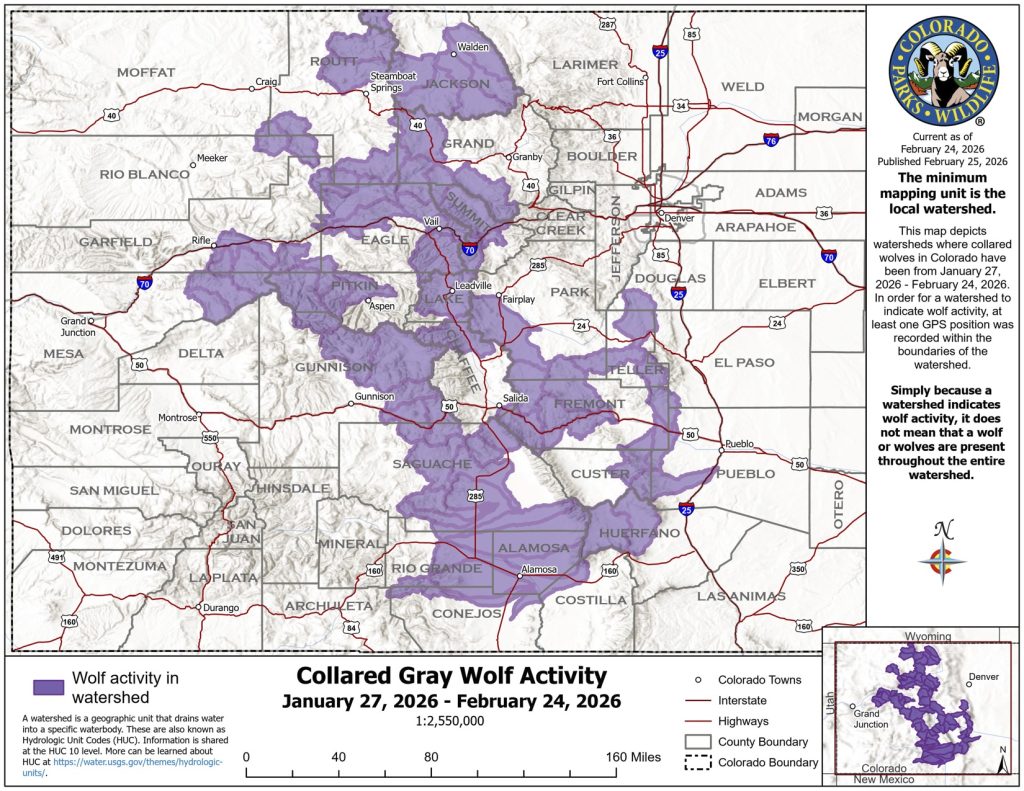
Colorado’s wolves made their first appearance within some southern Front Range watersheds in February.
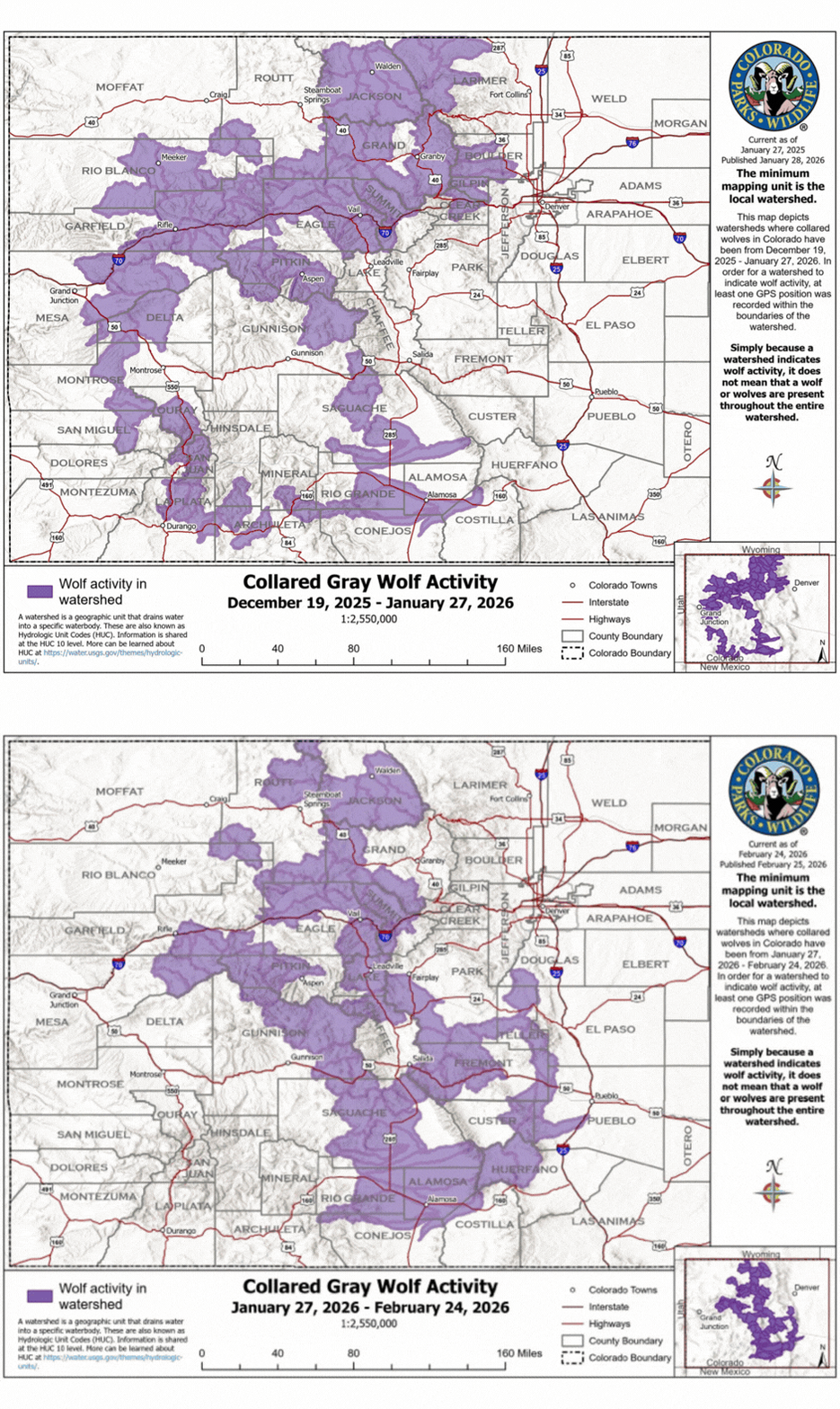
Colorado Parks and Wildlife’s latest gray wolf activity map — which shows the watersheds where the state’s collared wolves were located between Jan. 27 and Feb. 24 — indicates that wolves moved through several watersheds in the San Luis Valley, including those overlapping with portions of Teller, Custer, Douglas and Pueblo counties.
According to the agency, the activity in the southeast is attributed to two individual wolves that were moving separately throughout this region.
Parks and Wildlife continues to report that no wolves have crossed over east of Interstate 25 or spent time near urban centers.
This activity represents a slight shift away from some of the southwestern counties where wolves were located in the previous 30 days. Wolves continued to explore watersheds in Delta, Mesa, Gunnison, Saguache, Rio Grande, Conejos and Alamosa counties.
If a watershed is highlighted, it means that at least one GPS point from one wolf was recorded in that watershed during the 30-day period. GPS points are recorded roughly every four hours.
While the latest map shows continued exploration by wolves traveling the state, it also shows continued action in several northwest Colorado watersheds touching parts of Rio Blanco, Routt, Jackson, Grand, Summit, Eagle, Pitkin and Garfield counties. This includes the region where Colorado’s four established packs have set up: the Copper Creek Pack in Pitkin County, the King Mountain Pack in Routt County, the One Ear Pack in Jackson County and the Three Creeks Pack in Rio Blanco County.
The King Mountain Pack’s patriarch was killed in late January during a Parks and Wildlife capture operation. The wolf, tagged 2305, was among those translocated from Oregon in December 2023. The wildlife agency reported that operations were “routine” to replace low batteries on the GPS collars worn by the pack’s breeding pair.
The wolf’s death was the second this year and the 12th of the 25 wolves Colorado has translocated as part of its gray wolf reintroduction effort.
Of the 13 surviving reintroduced wolves, seven are part of a breeding pair. Nine are female and four are male. The four surviving wolves born to the Copper Creek pack in 2024 — three males and one female — have reportedly dispersed from their pack.
This could mean there are at least 10 dispersing wolves in Colorado, as February marks the start of the breeding season for gray wolves. According to Luke Perkins, a spokesperson for Parks and Wildlife, the agency had not confirmed any additional breeding pairs as of Feb. 5.
In January, Parks and Wildlife announced that it would not release any more wolves this winter after its plans to secure additional wolves from British Columbia were impeded by a change in federal direction about where Colorado can source wolves. Looking forward, the agency will continue to pursue the wolf plan’s goal of releasing 30 to 50 wolves in the first three to five years of the restoration.





Support Local Journalism
Support Local Journalism
Readers around Glenwood Springs and Garfield County make the Post Independent’s work possible. Your financial contribution supports our efforts to deliver quality, locally relevant journalism.
Now more than ever, your support is critical to help us keep our community informed about the evolving coronavirus pandemic and the impact it is having locally. Every contribution, however large or small, will make a difference.
Each donation will be used exclusively for the development and creation of increased news coverage.