How Western Slope voters helped reelect Hickenlooper amid Colorado’s wave of progressive upsets
State Sen. Julie Gonzales received the majority of votes in Denver County during the Democratic primary, but faced obstacles with communicating her message to more rural parts of the state
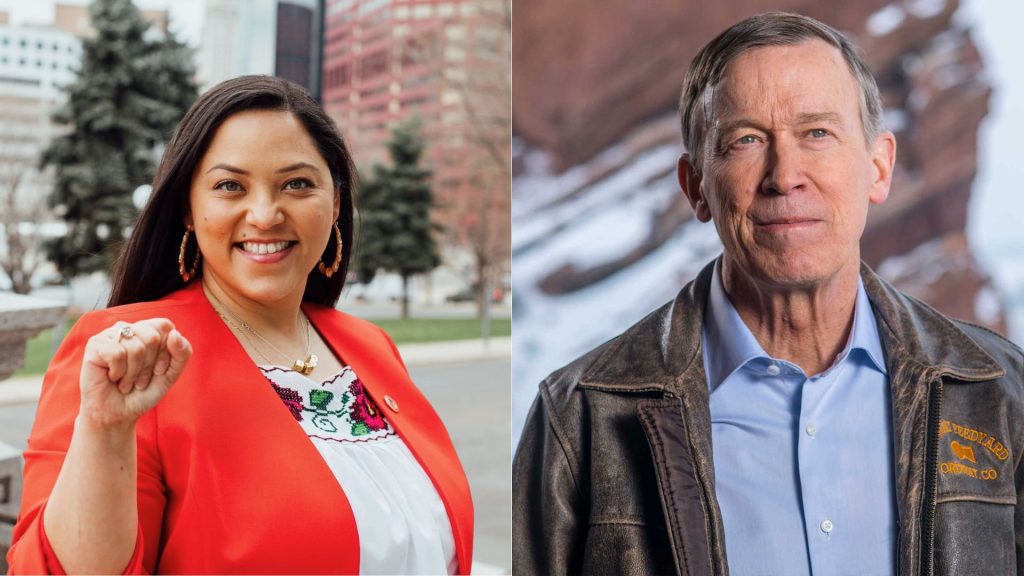
Courtesy photos
Amid a wave of wins for anti-establishment candidates, Colorado’s rural mountain towns were more likely than the Front Range to vote for veteran incumbents, helping to secure a win for U.S. Sen. John Hickenlooper against a progressive challenger.
Western Slope residents predominantly voted for incumbent U.S. Sen. John Hickenlooper, who swiftly took the victory in Colorado’s Democratic Senate primary race against state Sen. Julie Gonzales. The Associated Press called the race just 36 minutes after preliminary results were released.
Hickenlooper’s win diverges from a notable losing streak for establishment Democrats and incumbent moderates in major Colorado races (as well as states like New York and Maine), including Democratic socialist Melat Kiros’s defeat of 15-term incumbent Rep. Diana DeGette in Colorado’s 1st Congressional District and Colorado Attorney General Phil Weiser’s gubernatorial win over U.S. Sen. Michael Bennet.
“I do believe, and I’ve remained committed to the idea, that no candidate should expect to just continue to serve in their seat,” Gonzales said. “I think the election results on that front were extraordinarily clear.”
So why didn’t Gonzales win?
While much of the support for Gonzales was concentrated in counties around the Front Range, Hickenlooper outperformed his opponent across the Western Slope and in most Eastern Plain counties.
More than 54% of Denver residents voted for Gonzales, where she currently serves her second term in Colorado’s 34th Senate district. Neighboring counties saw close margins, with the challenger receiving 49.99% of the vote in Adams, 48.6% in Boulder and 48.6% in Larimer counties, according to unofficial results from the Colorado Secretary of State.
On Colorado’s Western Slope, votes for Hickenlooper were much higher across various counties: 73% in Pitkin, 68% in Routt, 67% in Eagle, 64% in Summit, 61% in Grand and 60% in Garfield. This voting pattern is not unlike what the state saw for Colorado’s Governor race, where Bennet received more votes in rural mountain regions including Summit, Pitkin, Routt and Moffat counties.
Results for the Democratic Senate primary have only tightened as more votes have been counted since June 30. When the Associated Press called the race, Hickenlooper was leading with 57% of the vote. Now, leading by a more modest 52.9% — roughly 51,000 votes statewide — Gonzales said Hickenlooper’s win as a veteran incumbent is largely supported by a resource advantage, and a strategic decision to avoid debating her.
Despite Gonzales’s active campaigning for a public debate with Hickenlooper, the two never participated in any transitional, face-to-face debates ahead of the Democratic primary.
Hickenlooper previously stated that weekly trips between Colorado and Washington, D.C., had kept him too busy to accept any debate invitations. Gonzales, however, said she felt her opponent’s refusal to debate her was a strategic decision and a “disservice to Colorado voters.”
“Democrats talk a lot about wanting to defend Democracy. But you can’t defend Democracy and then also avoid (going) and actually engaging in the work of Democracy, of speaking to potential voters and talking about the issues” she said. “I think there was a real missed opportunity here (by) not holding a debate.”
Even without a debate, Gonzales came closer to defeating Hickenlooper than his 2020 Democratic primary opponent, Andrew Romanoff, who secured 41% of the vote compared to Gonzales’s 47%. Gonzales outperformed Romanoff in 42 out of the 64 counties.
“What that, to me, demonstrates is that Coloradans are hungry for a fighter, for a battle-tested champion to fight for working people,” Gonzales said. “What is also clear, though, is that we had a vision that we were testing that not only should the Democratic Party work to build a governing majority, flip red seats to blue, but so too should we examine the caliber of leaders that we send to D.C. in the first place.”
Hickenlooper’s team did not respond to a request for comment before publication.
Reaching voters on the Western Slope
One of the biggest challenges for Gonzales’s campaign was name recognition. Hickenlooper, on the other hand, has been in office since 2003 — serving as Denver mayor, Colorado governor and U.S. Senator.
Having collected around $870,000 in campaign funding and spent $643,000 through June 10, compared to Hickenlooper’s roughly $6.2 million in spending, Gonzales didn’t have the resources to spend on widespread campaign ads like her opponent did, meaning some voters outside of Denver may have been unfamiliar with her policies when the time came to cast their ballots.
Polls conducted prior to the election had called Gonzales a formidable challenger, with one stating she was “in a strong position to stage an upset and emerge victorious” on the condition that voters were sufficiently informed about both candidates.
Conducted by Working Families Party, a progressive political organization, the February poll of 739 likely Democratic primary voters in Colorado found that support for Gonzales picked up significantly after voters were given neutral-to-positive bios on both candidates. When presented with a balanced number of positive and negative arguments about each candidate, Gonzales emerged as the favorite in the poll despite Hickenlooper’s strong lead and widespread name recognition.
Gonzales said she “absolutely” faced challenges with getting her message across more remote areas of the state, adding that she felt the outcome of the election could have been different had she had more time and resources. Gonzales had roughly seven months to win over voters between launching her campaign for U.S. senator in December 2025 and the June primary.
“Hats off to Sen. Hickenlooper, because he outspent me 10 to 1,” Gonzales said. “We just weren’t able to communicate our message and our vision to voters who I think otherwise would have been really hungry … to really discern who they’d like to see in that position.”
She added, “With that being said, I’m incredibly proud that we … came within six points of electing Colorado’s first woman, first Latina, to the U.S. Senate in our state’s history. We accomplished that while being massively outspent and without the benefit of a single debate.”
While Gonzales said she feels proud of having connected with so many voters across the state, she also lamented the passiveness of organizations whose purpose it is to help elect women, Latinos and progressives into government.
“What is clear is that (these organizations) largely stayed out of this race because they didn’t see the vision of replacing do-nothing Democrats with battle-tested champions,” she said. “I think the piece that I’m most proud of is that, now, any of those organisations are looking at those results and saying, ‘Damn. We missed it. We’re so proud of what you accomplished.'”
In terms of what’s next, Gonzales said she intends to spend time reflecting on what she’s learned throughout the campaign, and celebrate what she has accomplished.
“The work continues, regardless of position or title,” she said. “I look forward to continuing to visit with those communities and work alongside them to advance an economy that works for everybody, justice and dignity for all Coloradans, no matter who you voted for in the last election.”




Support Local Journalism
Support Local Journalism
Readers around Glenwood Springs and Garfield County make the Post Independent’s work possible. Your financial contribution supports our efforts to deliver quality, locally relevant journalism.
Now more than ever, your support is critical to help us keep our community informed about the evolving coronavirus pandemic and the impact it is having locally. Every contribution, however large or small, will make a difference.
Each donation will be used exclusively for the development and creation of increased news coverage.