Colorado Parks and Wildlife kills second yearling from One Ear Pack as livestock attacks continue in Grand County
It’s the third wolf the agency has removed this week — raising questions about the efficacy of these removals and concerns about the state’s reintroduction

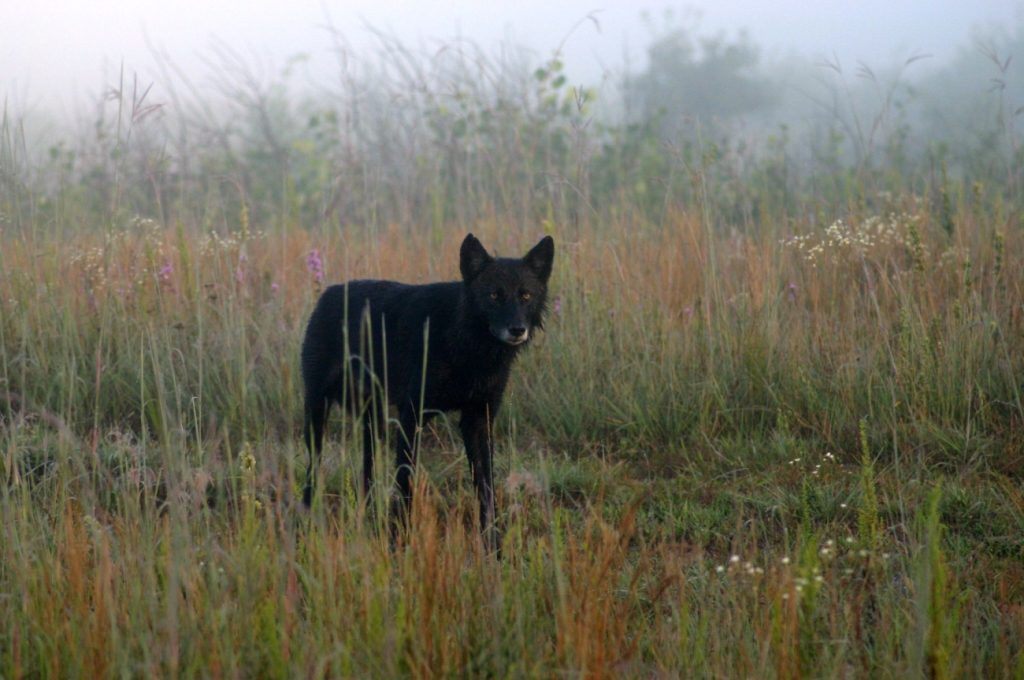
Mary Jane Bean/U.S. Fish and Wildlife Service
Colorado Parks and Wildlife killed a female yearling from the One Ear wolf pack on Wednesday, Sept. 9, following the pack’s continued predation on livestock in Grand and Jackson counties.
It’s the second wolf the agency has euthanized from the pack in the past month and the third wolf this week, after it killed yearlings from the Copper Creek and Three Creeks packs on Monday. The sharp increase in these lethal removals is raising concerns from some advocates not only about their efficacy, but also about the state’s management of wolves.
The authority to kill wolves in Colorado, despite their federally protected status, is granted by its special 10(j) rule with the U.S. Fish and Wildlife Service. Parks and Wildlife’s goal in killing a member of a wolf pack that is repeatedly attacking livestock is to change the group’s behavior — discouraging them from attacking livestock and encouraging them to hunt their natural prey instead.
Parks and Wildlife’s decision to euthanize a chronically depredating wolf — defined as three or more depredation events in 30 days — is also guided by an agency management directive. If the definition is met, impacted producers have utilized appropriate nonlethal deterrence methods, and lethal removal is likely to change pack behavior, the agency can kill the responsible animal or animals.
The state wildlife agency killed the first yearling from the One Ear Pack on Aug. 4 after the pack was connected to four attacks on calves between June 29 and Aug. 1 in Jackson and Grand counties. In its Wednesday news release, Parks and Wildlife reported that, since Aug. 4, the pack has been tied to seven additional livestock attacks despite attempts from the agency and affected producers to mitigate conflict between cattle and wolves.
After the first euthanization in August, Parks and Wildlife said it “worked closely with the affected producers to implement a variety of nonlethal deterrence methods,” including increased monitoring of wolves using cameras, active human presence, range riders and hazing.
Parks and Wildlife’s euthanization of this wolf marks a significant increase in lethal removals this summer as conflict between Colorado’s growing population of wolves and livestock has increased.
“Increased wolf movement in the summertime, in combination with livestock distribution across open allotments, can lead to increased encounters with wolves, and it has,” said Parks and Wildlife Director Laura Clellan at the agency’s Sept. 2 commission meeting. “These remote open allotments cover tens of thousands of acres and commonly include rough terrain that’s hard to access and traverse. Some of the most effective tools during this time of year are range riders and game cameras that support continuous monitoring and adaptive responses. This is where CPW’s efforts are focused at this time.”
Wolf and wildlife advocates, however, are concerned about the number of lethal removals the agency has taken this year.
“Regardless of whether these instances meet the definition of chronic depredation, the fact is that CPW has a legal mandate to restore wolves as a self-sustaining population, and they’re taking that population — that very nascent population —and whittling it down, which is not the direction we want to be going,” said Rob Edward, president of the Rocky Mountain Wolf Project, which helped bring forward the ballot measure that mandated Colorado to restore wolves.
Action raises concerns over state management of wolves

Prior to this summer, the state wildlife agency had killed one wolf in Colorado under this authority. This summer, it has killed five. Per its online tracker of depredations, Parks and Wildlife has confirmed 28 livestock attacks between June 1 and Sept. 10 this year — compared to 11 during the same time last year.
“Right now, producers and wolves are not winning,” said Tim Ritschard, president of the Middle Park Stockgrowers. “Depredations are at an all-time high with roughly 30 wolves on the ground plus an unknown number of pups.”
In the One Ear Pack’s territory — which spans from northern Jackson County into Grand County — Ritschard said the 10 confirmed depredations speak for themselves.
“The One Ear Pack is causing hell to producers,” he said. “Everyone is riding their cows, trying to find depredations. With the drought, other predators are getting to these animals before producers can. One would have to believe these depredation numbers are higher.”
While Ritschard said he was grateful the agency used lethal management to remove wolves chronically depredating, he believes it highlights flaws with the current chronic depredation plan and is part of a larger concern.
“We have a management issue that is being politically influenced, and if CPW could do their job without that influence, I think we would be at a different point today than we are right now,” he said.
Edward acknowledged that some conflict is likely to occur as the “wolves out on the landscape are encountering a matrix of livestock operations and wild prey.”
However, he said the hope is that as the state learns about where the wolves are settling, “everything should be done, everything should be tried in terms of helping to redirect the wolves away from thinking livestock are the easiest option.”
Continuing to kill wolves as Colorado has been “sets up this perverse incentive to be transient about actually truly embracing non-lethal coexistence measures by just going ahead and killing the wolves,” he added.
“We hope these incidents help to shine the light on the need for CPW to start taking a different approach and being less willing to kill wolves, and figure out a way forward that helps address the ranchers’ needs, but also helps to facilitate forward momentum for the program,” Edward said.
Part of the concern of Rocky Mountain Wolf Project and other advocacy groups is that Parks and Wildlife was unable to release additional wolves this past winter after interference from the federal government.
“Colorado can’t keep killing wolves when it already has so few left and no additional reintroductions are in sight,” said Samantha Miller, a senior carnivore campaigner at the Center for Biological Diversity, in a statement. “Killing three endangered wolves in a single week amounts to internal sabotage by an agency that’s failing to take its responsibility for wolf recovery seriously.”
Edward added that Parks and Wildlife needs “to seriously think about a moratorium on lethal control unless it’s absolutely the last resort, and everything else has been tried, because every wolf that is on the ground in Colorado right now is tremendously valuable to the success of the program.”
Does lethal removal reduce conflict between wolves and livestock?
The agency returning the One Ear Pack for a second euthanization has also raised questions from some about the efficacy of Parks and Wildlife’s incremental approach to these lethal removal operations.
“Talking with people who have been dealing with this in other states, removing yearlings only kicks the can down the road,” Ritschard said. “We are going to have the same issues next year if something different is not done.”
Jen Clanahan, executive director of the Colorado Nature League, said in a statement that “the fact that CPW has gone back multiple times to kill wolves in the same pack” not only raises efficacy concerns, but also questions about whether the agency is killing the right wolves involved in the conflicts.
Edward said that “everything that we’ve heard indicates that they are purposefully not targeting the breeding pair, which is likely the wolves that are actually depredating, but if they do, then, they’re killing the breeding pair.”
Parks and Wildlife’s management directive recommends that lethal removal efforts target responsible wolves “to the extent possible,” and minimize the number of wolves that need to be killed. It has also acknowledged in lethal removal reports that “removing a breeder has greater implications on pack structure than removing a non-breeder” and that “yearling males are less crucial to the success of a population than other members.”
“So, in one instance, I think they’re making a hard choice and perhaps the best of all the bad decisions, but the bigger question is, were there things they weren’t able to try, didn’t try, short of killing wolves?” Edward said. “This just random searching for any member of the pack short of the breeding pair to kill as a — I don’t know what it is — a peace offering to the ranchers, it doesn’t have a significant amount of efficacy as far as published science can tell us.”










Support Local Journalism
Support Local Journalism
Readers around Glenwood Springs and Garfield County make the Post Independent’s work possible. Your financial contribution supports our efforts to deliver quality, locally relevant journalism.
Now more than ever, your support is critical to help us keep our community informed about the evolving coronavirus pandemic and the impact it is having locally. Every contribution, however large or small, will make a difference.
Each donation will be used exclusively for the development and creation of increased news coverage.