As Colorado’s winter driving rules take effect, a new traction law is providing clarity for two-wheel-drive vehicles
Colorado’s updated passenger vehicle traction law clarifies which kinds of vehicles it applies to
Ryan Spencer/Post Independent
Colorado’s winter traction laws, which require drivers to prepare for snowy conditions, are now in effect.
The state’s passenger vehicle traction and commercial vehicle chain laws took effect Sept. 1, according to a news release from the Colorado State Patrol. These laws — which apply to all vehicles driving on the Interstate 70 mountain corridor and other mountain roads — are designed to keep traffic moving safely during icy and snowy conditions.
“Preventing traffic gridlock is top of mind as we start to think about winter conditions across Colorado,” said Colorado State Patrol Chief Matthew C. Packard in a statement. “Snow and ice can impact a vehicle of any size, so now is the time to check the condition of your tires and check that you have chains.”
Some of Colorado’s high peaks have already seen a possible dusting of snow — and transportation officials warn that icy conditions can strike at any time in the mountains as winter approaches. The traction laws will remain in effect through May 31.
GoI70 Executive Director Jonathan Godes wrote in a blog post that all drivers should check their tires, understand whether their vehicle complies with the state’s traction laws, consider buying chains or a traction device and learn how to install them before their first winter trip.
“If you travel between the Front Range and the mountains, now is a good time to make sure your vehicle — and your tires — are ready,” Godes said.
New law clarifies passenger vehicle traction requirements
A new law passed during the last legislative session clarifies the requirements of Colorado’s passenger vehicle traction law, after state lawmakers last year admitted that unintentional changes led to confusion around the law.
House Bill 26-1237, which was signed into law May 5, updates the passenger vehicle traction law to apply to all vehicles, including two-wheel-drive vehicles as well as four- and all-wheel-drive vehicles.
Under the passenger vehicle traction law, the Colorado Department of Transportation can restrict travel on roads, like I-70 and mountain passes, when they are snowy or icy if vehicles do not meet minimum traction requirements. During these times, CDOT will announce that the passenger vehicle traction law is active via variable message boards along mountain highways and on the state’s interactive map available at COTrip.org.
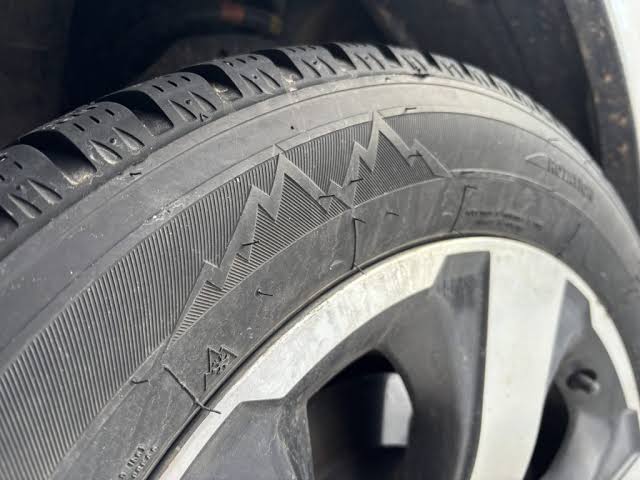
The law requires all passenger vehicles to have tires with a tread depth of at least 3/16-inch and rated as “all weather” or “mud and snow” tires. Drivers can look for markings stating “All season,” “M+S” “M/S” or an icon of a mountain with a snowflake to determine whether their tires meet the requirements, according to state officials.
If passenger vehicles do not have the proper tread depth and tire type, the law requires drivers to have chains or an approved alternative traction device on two or more tires when the law is activated.
There is a $50 fine plus a $17 surcharge for violating the passenger vehicle traction law, according to the State Patrol.
Colorado also has a passenger vehicle chain law, which, when in effect, requires all drivers on mountain roads to put on chains or an approved traction device, regardless of whether the vehicle has snow or all-season tires.
CDOT officials have said that activation of the passenger vehicle chain law is “exceedingly rare.”
The law was last activated during a bomb cyclone event in March 2019.
Commercial vehicles must carry chains
The commercial vehicle chain law requires all vehicles over 16,000 pounds to carry chains at all times when driving in the mountains between Sept. 1 and May 31, because of the unpredictable weather.
Under the law, commercial vehicles are required to chain up when CDOT activates the chain law on mountain roadways.
In recent years, the State Patrol has proactively enforced the commercial vehicle chain law during winter months by conducting chain checks at ports of entry where semitrailers are required to stop.
In 2024, Colorado expanded the number of roadways where the commercial vehicle chain law applies to include I-70 west of Mile Post 259 at Morrison, Colorado Highway 9 between Frisco and Fairplay, U.S. Route 285 from Morrison to the New Mexico border, U.S. Route 50 from Salida to the Utah border and Route 40 from Empire to the Utah border, among others.
The penalty for commercial motor vehicles that fail to comply with the winter driving restrictions is a fine up to $500 plus a $79 surcharge, or up to $1,000 plus a $157 surcharge, if the vehicle is stuck and blocking a traveled portion of the roadway, according to the State Patrol.








Support Local Journalism
Support Local Journalism
Readers around Glenwood Springs and Garfield County make the Post Independent’s work possible. Your financial contribution supports our efforts to deliver quality, locally relevant journalism.
Now more than ever, your support is critical to help us keep our community informed about the evolving coronavirus pandemic and the impact it is having locally. Every contribution, however large or small, will make a difference.
Each donation will be used exclusively for the development and creation of increased news coverage.