Eagle County rancher reports employee killed King Mountain wolf pack matriarch
The incident was reported in a recent letter to the U.S. Fish and Wildlife Service as it evaluates Colorado’s wolf reintroduction

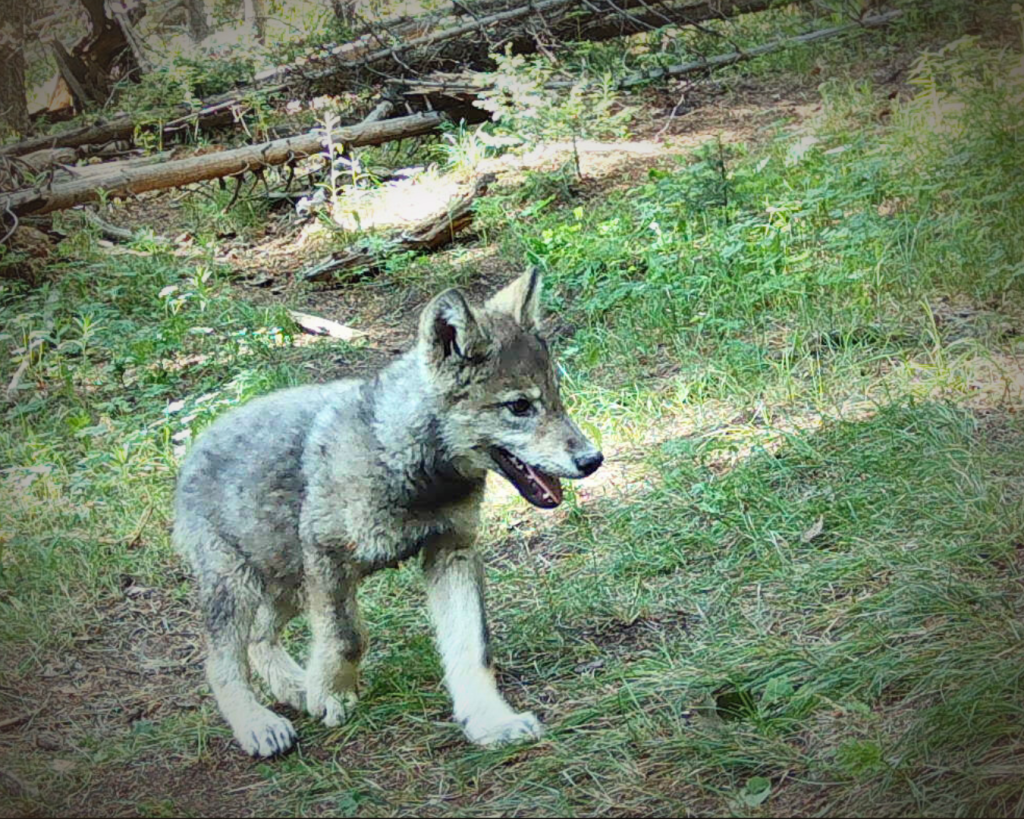
Colorado Parks and Wildlife/Courtesy Photo
The King Mountain wolf pack’s matriarch was reportedly killed by a ranch hand while it was approaching cattle in northwest Colorado, according to new details revealed in public comment sent to the U.S. Fish and Wildlife Service.
Colorado Parks and Wildlife announced on March 13 that the pack’s breeding female had died two days prior. The wolf’s death came six weeks after the pack’s patriarch died during a collaring operation in Routt County. Parks and Wildlife is leading the investigation into the female wolf’s death in consultation with Fish and Wildlife.
Susan Nottingham, a fourth-generation rancher who owns and operates a 20,000-acre cattle ranch spanning between Eagle and Routt counties, detailed in a letter to Fish and Wildlife the impacts that wolves have had on her livelihood and property, particularly after the King Mountain Pack set up a den nearby in the spring of 2025.
“This is also an incredibly cruel situation for the animals involved,” Nottingham wrote. “The wolves are not at fault; they simply do not belong here and can’t survive. Meanwhile, the emotional and financial stress on ranchers is immense and ongoing.”
Nottingham’s letter was one of over 1,000 comments submitted to the U.S. Fish and Wildlife Service as of June 4 in response to the agency’s request for information on how Colorado Parks and Wildlife is handling the wolf reintroduction program.
“The wolves were released just 75 miles from my community and soon made their way here,” Nottingham wrote.
She adds that after the King Mountain Pack was established, she “suspected several wolf-related depredations” in the summer that Parks and Wildlife “refused to confirm,” and then “three confirmed depredations” within 30 days in October. According to Parks and Wildlife’s website tracking its confirmed wolf depredations, three calves were killed in Routt County during three separate incidents on Oct. 12, Oct. 29 and Nov. 4, each with a claim settled for $2,899.
After the pack’s male died, Nottingham wrote that the female and four pups “moved into my hay meadows where I calve out 1,100 cows.”
“One of my employees ended up shooting the mother female,” she wrote.
The Vail Daily reached out to Nottingham on June 4 to talk about the incident, but she declined to comment until Parks and Wildlife concludes its investigation. Luke Perkins, public information officer, said the agency was “unable to share more information, including a final determination of the cause of death, while the investigation is ongoing.”
In an interview with the Fort Collins Coloradoan, which first reported the shooting on June 1, Nottingham said the wolf had been running toward a mother cow and two calves when one of her ranch hands fired two warning shots and a third shot toward the wolf.
According to the interview, the employee saw the wolf running away and did not know whether it had been hit or injured in the incident. The incident reportedly took place on March 10, one day before Parks and Wildlife received a mortality signal from the wolf’s collar.
Despite wolves being protected under the federal Endangered Species Act, as part of Colorado Parks and Wildlife’s special 10(j) permit with the Fish and Wildlife Service, individuals are legally allowed to injure or kill a wolf when it is “observed in the act of attacking livestock or working dogs.”
Colorado state statute defines “in the act” as “the actual biting, wounding, grasping or killing of livestock or working dogs, or chasing, molesting or harassing by wolves that would indicate to a reasonable person that such biting, wounding, grasping or killing of livestock or working dogs is likely to occur at any moment.”
Per the 10(j) rule, the state wildlife agency is able to retroactively grant a lethal take permit when the situation meets a few requirements, including reporting the incident to Parks and Wildlife no later than 72 hours after taking place. The incident must also take place on the applicant’s private property or on land where they have a valid lease to graze livestock. Additionally, the applicant is required to preserve evidence of the wolf attack on livestock.
Nottingham told the Coloradan that the evidence proved the wolf was caught in the act.
Killing gray wolves in Colorado, where they are listed as endangered both by the state and the federal Endangered Species Act, is illegal without authorization. Parks and Wildlife can prosecute illegal poachers under civil or criminal statutes, with fines up to $100,000, up to one year in jail or suspension of hunting privileges for anywhere from one year to life. Federal prosecution can result in a maximum fine of $50,000 and up to one year in jail.
“The investigation is still ongoing and extremely stressful, costing me tens of thousands of dollars in legal fees to protect myself and my employee from facing criminal charges,” Nottingham wrote in her comment to Fish and Wildlife.
Since Colorado began its reintroduction in 2023, only one other wolf death in Colorado — of 14 reported wolf mortalities to date — is being investigated as illegal poaching. The necropsy of the Copper Creek male, who died in a sanctuary in September 2024 after being captured following repeated livestock attacks in Grand County, revealed that a gunshot wound was the animal’s ultimate cause of death. The death is still under investigation by the U.S. Fish and Wildlife Service.
In addition to reporting the wolf’s death in the letter, Nottingham details how wolf reintroduction has impacted her life and relationship with Parks and Wildlife. In addition to the reported depredations, Nottingham claims that “due to the presence of wolves, I was unable to keep cattle in their designated pastures, disrupting the (grazing management plan with the U.S. Forest Service) entirely.”
She goes on to say it was a challenge to keep track of the herd and that she was 60 calves short in the fall, which she equates to $180,000. Nottingham adds that despite impacts, Parks and Wildlife’s response was to supply a range rider for the summer, who she said was “inexperienced” and “ineffective.” Later in the letter, Nottingham refers to the agency’s management strategies as “severely lacking.”
“CPW cannot effectively manage the wolf population and maintain ranching on the landscape,” Nottingham wrote.







Support Local Journalism
Support Local Journalism
Readers around Glenwood Springs and Garfield County make the Post Independent’s work possible. Your financial contribution supports our efforts to deliver quality, locally relevant journalism.
Now more than ever, your support is critical to help us keep our community informed about the evolving coronavirus pandemic and the impact it is having locally. Every contribution, however large or small, will make a difference.
Each donation will be used exclusively for the development and creation of increased news coverage.