Rival ballot initiatives ask Coloradans: Tax lower incomes less and higher earners more — or maintain the status quo?
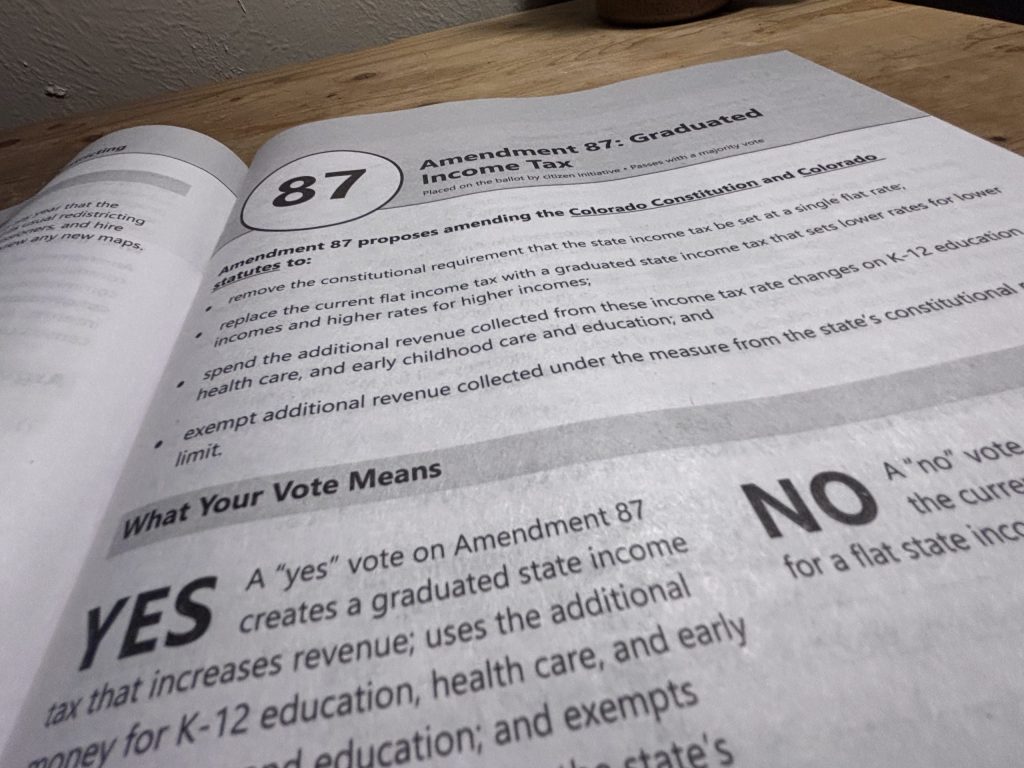
Amendment 87 proposes a graduated income tax system, while Proposition 136 aims to cap the flat tax rate that currently exists in the Colorado Taxpayer Bill of Rights


Austin Colbert/The Aspen Times
Colorado voters will find two citizen initiatives — Amendment 87 and Proposition 136 — on their ballots this November that propose dueling visions for the state’s income tax system.
Led by a coalition of progressive groups known as Protect Colorado’s Future, Amendment 87 would replace the state’s flat income tax with a graduated system, which raises or lowers taxes based on how much a person or business earns.
Amendment 87’s proposed tax system would lower taxes for the vast majority of Coloradans, while raising taxes on anyone with an income above $500,000, according to the official 2026 State Ballot Information Booklet. The increased tax on the wealthy would generate more than $2 billion annually that the ballot measure directs the state to spend on childcare, education and healthcare.
“When we talk about affordability in the High Country, we need to be really thoughtful about any decisions we make, including our tax structure and the state’s tax structure,” said Tamara Pogue, a Summit County commissioner and member of the steering committee for Protect Colorado’s Future.

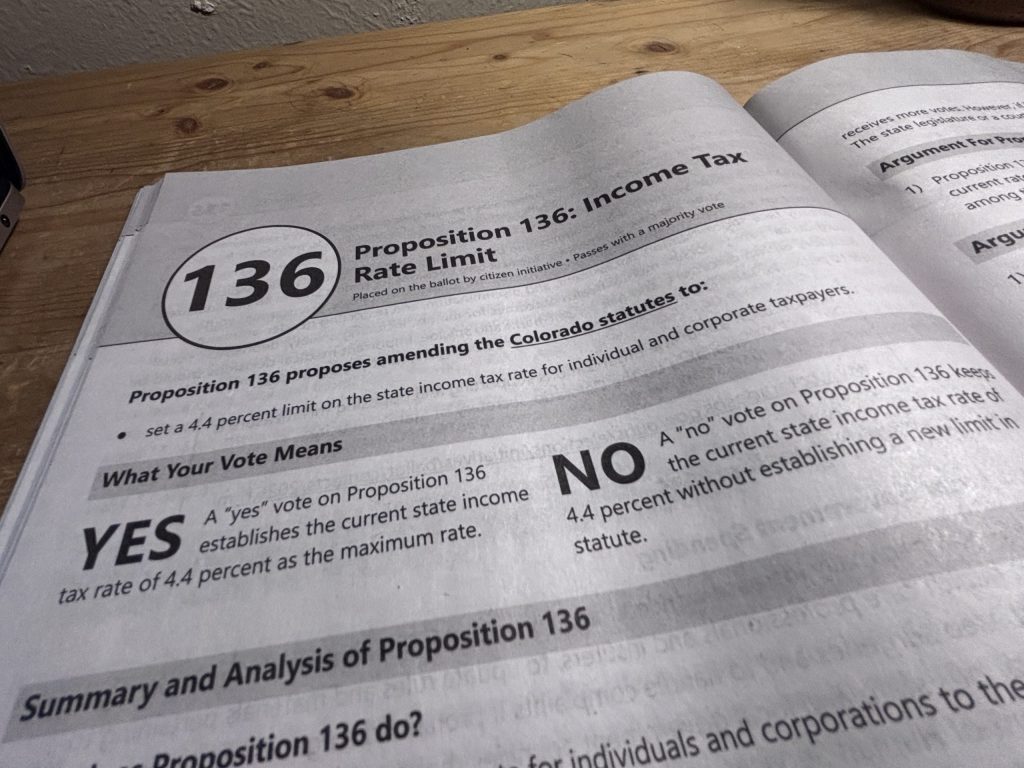
Proposition 136, led by the conservative think tank Advance Colorado, would cap the state’s flat tax rate, which applies to all Coloradans, regardless of income, at its current rate of 4.4%.
Advance Colorado Executive Vice President Kristi Burton Brown described Prop 136 as a “countermeasure to the progressive income tax” proposed by Amendment 87. She said Prop 136 aims to maintain the uniform tax rate that exists in Colorado’s Taxpayer Bill of Rights, or TABOR — preserving the status quo.
“Is this increasing taxes or is it lowering them? Well, it’s doing neither,” Brown said of Prop 136. “It’s basically saying, right now Colorado is like the third most expensive state in the nation. Everyone’s paying enough, and we should keep the income tax rate as it is.”
Colorado is one of 15 states with a flat tax rate. The federal government, as well as 27 states and Washington, D.C., use some form of a graduated income tax, while eight states have no income tax.
Both Amendment 87 and Prop 136 measures require a simple majority to pass.
Generally, when parts of voter-approved measures conflict, the measure that receives the most votes becomes policy. But if Amendment 87 and Prop 136 both pass, “the exact outcome is unclear,” and the state legislature or a court would need to determine how to resolve any conflicts, according to the ballot information booklet.
Coloradans could, of course, vote for both ballot measures — but each side is calling on voters to check “yes” on one and “no” on the other.
Election Day is Tuesday, Nov. 3. Ballots will be mailed to voters from Oct. 2-9.
How would Amendment 87’s graduated income tax work?
Protect Colorado’s Future is a coalition of dozens of nonprofits and advocacy groups from across the state. It includes progressive think tanks like the Bell Policy Center and Colorado Fiscal Institute, as well as groups like the Colorado Organization for Latina Opportunity and Reproductive Rights, the Colorado Consumer Health Initiative, the Colorado Cross-Disability Coalition, Hunger Free Colorado, the Colorado PTA and others.
The coalition wants Coloradans to vote ‘Yes’ on Amendment 87, which it calls the Income Tax Fairness Act — and ‘No’ on Proposition 136.
Protect Colorado’s Future argues that the state’s existing flat tax rate is unfair because “nurses, teachers, working families and small businesses pay the exact same income tax rate as millionaires and giant corporations.” The graduated income tax proposed by Amendment 87 accounts for the reality that lower-income families spend a greater proportion of their earnings on basic necessities and other taxes, like sales taxes, according to proponents.
Amendment 87, if passed, would remove Colorado’s constitutional requirement that income be taxed at a flat rate and would create a graduated income tax starting in 2027.
The proposed graduated income tax would create six brackets: Income under $25,000 would be taxed at 3.7%; income between $25,000 and $100,000 at 4.2%; income between $100,000 and $500,000 at 4.4%; income between $500,000 and $750,000 at 7.4%; income between $750,000 and $1 million at 7.9%; and income over $1 million at 8.4%.
Each bracket applies to a range of income, with all taxpayers who earned income within that range paying the given rate, regardless of their total annual income.
A family that earned $125,000 annually would pay a rate of 3.7% on the first $25,000; a rate of 4.2% on the earnings between $25,000 and $100,000; and a rate of 4.4% on any earnings over $100,000. This family would owe $5,175, or $325 less than the $5,500 they would owe under current law, according to the ballot information booklet.
Under the proposed graduated income tax system, a family with a taxable income up to $500,000 would also pay $325 less in taxes, because of the lower tax rates on the first $100,000 in income.
Coloradans earning the median household income of $95,500 would see their tax bill go down by about $315.
Under Amendment 87, only those earning more than $500,000 would pay more in taxes. Those with taxable incomes over $550,000 would pay about $1,175 more in taxes, while those with incomes over $875,000 would pay about $11,550 in additional taxes; and those with incomes over $2 million would pay $55,925 more in taxes each year, according to the ballot information booklet.
In 2023, data from the Colorado Department of Revenue shows only about 1.7% of the nearly 3 million tax returns filed in Colorado reported an annual taxable income over $500,000.
The increased tax on high-income Coloradans is estimated to raise more than $2 billion in additional revenue for the state that the ballot measure states must be spent to expand funding for K-12 education, healthcare and early childhood care.
Pogue said Amendment 87 responds to the federal legislation H.R. 1, sometimes known as the One Big Beautiful Bill Act, though the commissioner said she chooses not to call it that. When H.R. 1 cut federal taxes with disproportionate cuts for the wealthy, she said it cut taxes in Colorado, since TABOR links the state tax code to the federal tax code.
When H.R. 1 was signed into law in July 2025, it immediately shrank the state’s income tax collections by about $1.2 billion, sending lawmakers scrambling to right-size the budget in a special session. The Colorado Fiscal Institute estimated the federal legislation gave Coloradans who earn more than $863,000 a tax cut of nearly $70,000, while the bottom 20% of earners received an average tax break of only $130.
“The state is struggling to figure out how to pay for the services Coloradans rely on,” Pogue said. “If Colorado were to vote for Amendment 87 and move away from a flat income tax rate to a graduated income tax rate, it would actually lower income taxes for 97% of Coloradans while also generating more money for the state to backfill what it’s lost, largely because of federal legislation like H.R. 1.”
Advance Colorado counters with Prop 136
Advance Colorado is advocating for Coloradans to vote ‘Yes’ on Prop 136 and ‘No’ on Amendment 87.
Brown said Advance Colorado introduced Prop 136 — which would keep Colorado’s flat tax rate of 4.4% without making any changes to the state’s tax code — because “we thought the progressive income tax hike might get approved and, if it did, voters definitely needed a different option.”
Brown has called Amendment 87 a “tax hike,” despite acknowledging that it would cut taxes for most Coloradans, because it raises taxes on income over $500,000 and results in additional revenue for the state that she said isn’t needed. She said Colorado’s flat tax is a fair system because it taxes everyone at an equal rate.
Brown said Amendment 87 would hurt the state’s economy because wealthy individuals and businesses would flee the state, rather than pay the increased tax, taking jobs with them. She said that Amendment 87 “was written very sloppily” and removed, rather than added, to the state constitution because its drafters didn’t want it to have to surmount the 55% threshold to add language to Colorado’s constitution.
Brown criticized the Colorado government for using fees to raise revenues and circumvent TABOR. She said the state legislature’s budget issues are the result of overspending on “unsustainable programs.”
“It’s more that principle that is the problem with Amendment 87, giving the government a $2.7 billion blank check at a time when Colorado is already extremely unaffordable and Colorado families are getting charged fees every time the legislature meets,” Brown said.
Pogue pushed back, stating that Amendment 87 is intentionally written and questioning the premise that wealthy individuals leave states that impose graduated income tax systems. She said the graduated income tax would save most Coloradans money, while also creating more money for the government to spend on programs that support everyday families.
Pogue said it is “disingenuous” for Advance Colorado to call Amendment 87 a “blank check” when the ballot measure ties revenues to childcare, K-12 education and health insurance — and requires an annual audit of state spending.
Brown also raised concern that Amendment 87 would hurt small businesses and working families, but Pogue said that it would result in tax cuts for both businesses and individuals making under $500,000.
“I don’t think this is wanton spending on behalf of the legislature. I think this is a fiscal challenge that’s created by TABOR,” Pogue said.
Brown also claimed that Amendment 87 “endangers state tax deductions for veterans, military personnel and senior citizens living on Social Security.”
But Protect Colorado’s Future has pushed back against that claim, stating that those deductions are all protected under the law and Amendment 87 would make no changes to them.










Support Local Journalism
Support Local Journalism
Readers around Glenwood Springs and Garfield County make the Post Independent’s work possible. Your financial contribution supports our efforts to deliver quality, locally relevant journalism.
Now more than ever, your support is critical to help us keep our community informed about the evolving coronavirus pandemic and the impact it is having locally. Every contribution, however large or small, will make a difference.
Each donation will be used exclusively for the development and creation of increased news coverage.