Colorado lawmakers vote to refer ballot question that would use TABOR refund money to fund K-12 schools
Supporters of a Democrat-sponsored ballot measure say TABOR spending could help address chronic underfunding in public schools, while opponents say reducing taxpayer refunds is not the solution


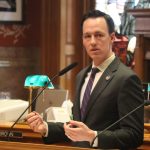
Robert Tann/Post Independent
A question headed to the November ballot will ask Colorado residents to give up money from their Taxpayer’s Bill of Rights refunds in order to increase funding for K-12 schools, after lawmakers passed a bill Tuesday that refers a ballot measure to voters.
Sponsored by Democratic lawmakers, Senate Bill 135 will leave it up to voters whether the state can retain and spend up to $4.6 billion more in tax money than the existing TABOR cap allows each year — funding that would otherwise be refunded to taxpayers under existing law. The measure passed with only Democratic support, clearing the Senate in a vote of 23-12 and the House in a vote of 42-21.
TABOR, approved by voters in 1992, limits the amount of money lawmakers can spend each year based on the rate of population growth plus inflation. Supporters of the ballot measure argue the TABOR cap has limited the state’s ability to adequately fund education.
The measure’s sponsors view the ballot question as a way to narrow the $3.5 billion gap in public school funding uncovered in a study commissioned by the Colorado Legislature in 2023.
“Education has languished in funding in Colorado for the last two decades, at least, and we are near the bottom of the nation when it comes to per-pupil funding,” said Colorado Education Association President Kevin Vick.
The Colorado Education Association is the largest union in the state and an affiliate of the National Education Association, with roughly 40,000 members representing education professionals across the state.
As educator shortages continue to present challenges for rural school districts, those thinking about leaving the profession largely credit low pay and high workloads for their decision. Today, Colorado ranks last in the nation for teacher wage competitiveness and 40th in the nation for education investment despite an above-average gross domestic product, according to the Colorado Education Association’s 2025-26 State of Education Report.
News you can trust. Straight to your inbox.
Sign up for our daily newsletter: PostIndependent.com/newsletter
“We are dead last when it comes to salary competitiveness. In fact, an educator in Colorado makes approximately 62 cents for every dollar that a like-educated professional makes in Colorado,” Vick said. “What that has resulted in is essentially a system that can’t keep educators in the profession, and that really hurts students.”
The Colorado Education Association, a major supporter of the ballot measure as part of its “Cut the Ropes” campaign, says the measure allows for an increase to K-12 funding without raising taxes — since it wouldn’t change tax rates or change anyone’s tax bracket.
Opponents of the ballot measure, on the other hand, say claiming the ballot measure wouldn’t raise taxes is misleading, arguing that the retention of surplus dollars will still result in less money in the pockets of Coloradans.
“We are pre-spending any possible surplus; that is a tax increase on the citizens of Colorado. Money that is overtaxed and then turned to retention is just confirming that it is a tax,” Rep. Ken DeGraaf, a Colorado Springs Republican, said during a Saturday discussion of the measure.
Voter approval on the ballot measure wouldn’t immediately grant Colorado $4.6 billion in additional spending. The ballot measure’s language allows the state to hold onto funding equal to the most the state has spent on K-12 funding through its general fund for 10 years, which is just under $4.6 billion. Because the TABOR surplus is based on how well the economy performs each year, however, totals can vary widely.
The state is currently projected to collect almost $20.7 billion in revenue subject to TABOR in fiscal year 2026-27 and $22 billion in fiscal 2027-28, according to the measure’s fiscal note. This means revenue subject to TABOR could exceed the cap by $136.1 million in 2026-27 and $969.7 million in 2027-28. If passed, the ballot measure would allow the state to retain and spend this surplus on K-12 education rather than refunding it to taxpayers.
Lawmakers believe that by increasing TABOR spending, they could generate up to $2 billion more for K-12 schools over the next decade.
Based on a tier system for spending laid out in the ballot measure, tax revenue retained by the state would first go toward increasing K-12 spending by 2% annually for the next decade, roughly $107.4 million during the 2026-27 fiscal year. This increase would reportedly be used to improve areas like teacher pay, teacher retention and allowing for smaller class sizes, according to proponents. They say some of the surplus beyond the 2% increase would be spent on children’s programs like full-day preschool and child care access.
Additionally, the state must first use retained revenue to cover reimbursements tied to the homestead property tax exemption before dedicating more of the surplus to education and children’s programs.
Rep. Chris Richardson, an Elbert County Republican, criticized the ballot question, saying it promises things the legislature cannot deliver, such as improving class sizes, teacher retention and teacher pay, which are functions of local school boards.
“Hope is not a method. Just putting it in the ballot question is not going to make it so,” Richardson said. “Leading voters to believe that that’s going to be the outcome if this passes is wrong. We can’t promise that, we should not be putting it in the ballot question.”
Additionally, several efforts by Democrats to raise the TABOR spending cap have failed in the past. In 2019, voters rejected Proposition CC, which would have permanently ended the cap by eliminating TABOR refunds. Voters later rejected Proposition HH four years later, which would have temporarily raised the cap and chipped away at refunds to offset proposed cuts to property tax revenue.
The simplicity and transparency of the ballot measure is what will make it more appealing to voters than past attempts, Vick said. The bill requires the Office of the State Auditor to prepare a report for each fiscal year describing how much revenue was retained under the bill and how the state spent the additional revenue.
Vick added that research conducted through a third party pollster showed that voters approved of the measure by a 2-1 margin.
“The real power of this measure is its simplicity and focus,” he said. “Previous attempts, especially in the last few years, have read like a novel on the ballot … and also were not focused or targeted for a specific thing that voters said they wanted to improve. So we took a look at those efforts and made a very conscious effort to make sure that this was singularly focused and very simple and easy to understand.”





Support Local Journalism
Support Local Journalism
Readers around Glenwood Springs and Garfield County make the Post Independent’s work possible. Your financial contribution supports our efforts to deliver quality, locally relevant journalism.
Now more than ever, your support is critical to help us keep our community informed about the evolving coronavirus pandemic and the impact it is having locally. Every contribution, however large or small, will make a difference.
Each donation will be used exclusively for the development and creation of increased news coverage.