Gray wolf activity in July concentrates in northwest Colorado, as state announces new pack, pups
Colorado had pups born to four new packs this spring

Colorado Parks and Wildlife/Courtesy photo
Editor’s note: This article has been updated to correct how many wolves are collared. Around half of Colorado’s wolf population is collared.
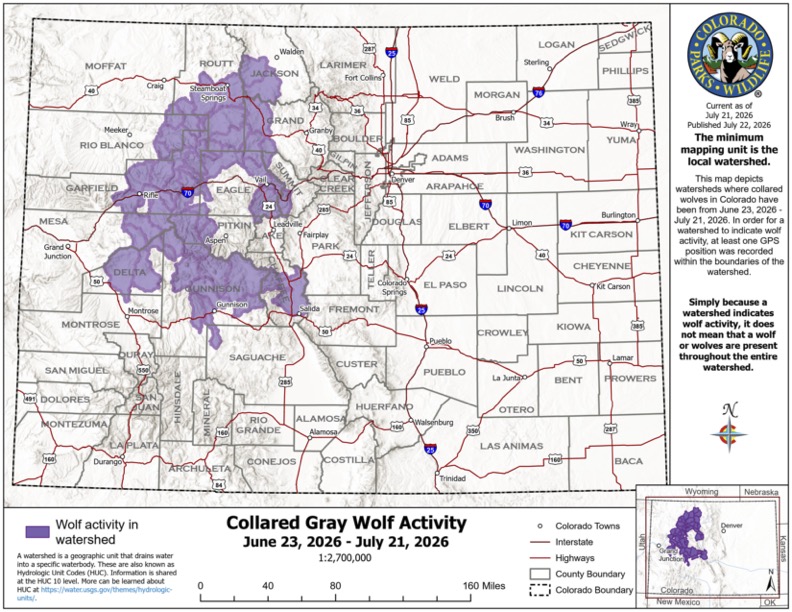
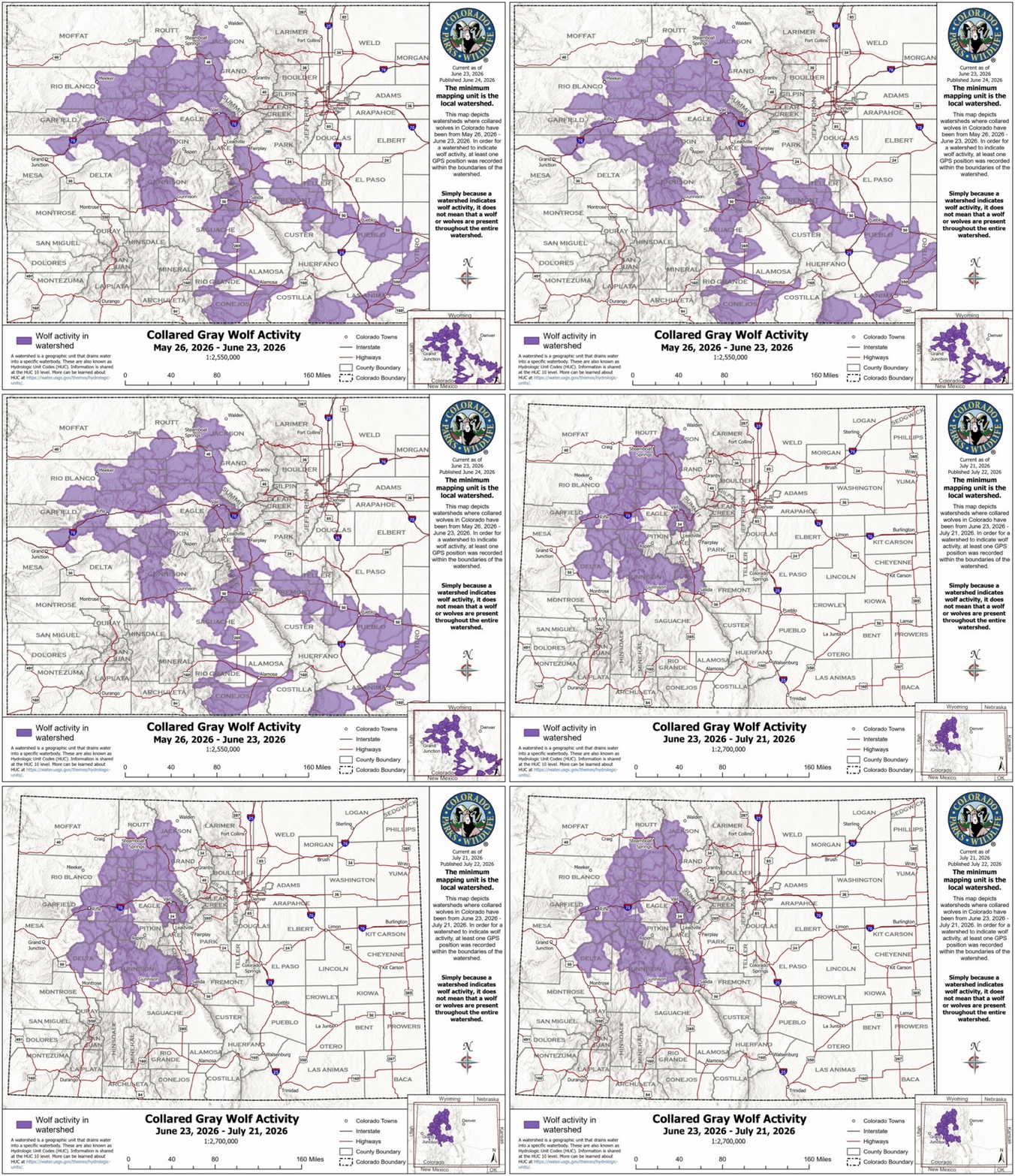
After June saw Colorado’s collared gray wolves covering large swaths of the state — including one briefly traveling east of Interstate 25 for the first time — the animals’ activity in July was concentrated in a portion of northwest Colorado.
This is according to the latest wolf activity map from Colorado Parks and Wildlife, which illustrates the watersheds where Colorado’s collared wolves were located between June 23 and July 21. The map shows wolf activity was primarily located in watersheds that span portions of Jackson, Grand, Routt, Rio Blanco, Eagle, Mesa, Delta, Gunnison, Summit, Pitkin and Chaffee counties.
This represents a departure from the expansive movements the previous months’ maps have illustrated.
Dr. Brenna Cassidy, wolf monitoring and data coordinator, said in a Wednesday interview that part of the reason is that the broader movements in past months’ maps are often the patterns of individual wolves. This includes the June movement map, which showed one wolf making a big loop to the south and east.
“They look like travel corridors, whether it’s one wolf or two wolves, and what we’re seeing here is just a little less of that long distance movement for this month,” Cassidy said.
Cassidy added that any guess at why they’re more centralized in northwest Colorado this month would be “pure speculation.”
“We could speculate that because it’s been so hot — wolves are made for winter — that maybe they’re not traveling as far because their thermal limit is being reached during the day,” she said. “It’s hard to say because they are all individuals and at higher elevation, it’s been cooler. Maybe it has something to do with where elk are. Elk calves are about two months old or so right now, and wolves hunt elk calves a lot during the summer. So maybe they’re in a great summer range for elk.”
The most likely rationale, however, is likely that it’s chance, Cassidy said.
“We have these individual wolves that are traveling around; they are looking for other wolves,” she said. “And they just so happen to be closer to the northwest kind of blob that you see on the map than in previous months. … It could look similar to having those long-distance loops in August.”
If a watershed is highlighted, it means that at least one GPS point from one wolf was recorded in that watershed during the 30-day period. GPS points are recorded roughly every four hours.
The map was released on the same day Parks and Wildlife announced that a new pack formed this spring in Eagle County. Dubbed the Piney Ridge Pack, it was one of four packs that successfully had wolf pups this year, the wildlife agency reported. The One Ear, Copper Creek and Three Creeks packs — in Jackson, Pitkin and Rio Blanco counties, respectively — also had litters.
All four of these packs and their territories are located in the northwest region highlighted in the July map.
“The four packs that are attending pups, they’re kind of sticky to a spot because pups are not gonna travel super far,” Cassidy said, adding that the adults “go out, hunt, get food and bring it back. So those packed territories are kind of reflected in the map.”
The region also includes the territory belonging to the King Mountain Pack. Both breeding adults in the pack, which originally formed in 2025, died earlier this year, so the pack did not reproduce this spring. The four yearlings born in 2025, however, are still considered a pack, Cassidy said.
“They are still traveling as a group; they’re generally on the same territory, even though they’re not anchored by a den,” she said.
Colorado’s nascent wolf population is still a mix of pack wolves and dispersing wolves — lone animals traveling broadly in search of a mate and quality habitat.
How many wolves are there in Colorado?
Parks and Wildlife estimated there were at least 32 wolves in Colorado as of March 31, including 18 adults and 14 pups. One of these adults — an uncollared wolf born to the Copper Creek pack in 2024 — was killed in June after it was tied to attacks on at least 22 sheep in Rio Blanco and Routt counties since July 2025. Around half of the state’s wolves are collared.
Of the 17 surviving adults, Cassidy said the majority are living as part of a pack. Being a part of a pack is incredibly important for wolves as a social predator, she emphasized.
“It’s everything from how efficient and successful packs are for hunting, how successful they are for raising pups, for recovering from injuries, illnesses as a pack member versus being on their own,” Cassidy said.
For Colorado Parks and Wildlife, there are benefits as well in terms of monitoring and preventing conflict between livestock and the wolves.
“When we have these long-distance travelers, it’s really next to impossible to predict where they’re going to go, but when a wolf is in a pack and has a territory, it’s defending, it becomes a little bit more predictable about where it’s going to be,” Cassidy said. “So, all of our conflict staff can make more educated and accurate predictions of how many resources we should allocate to this area versus this area that’s not in a territory.”
While some of Colorado’s lone, dispersing wolves are among the 25 that were translocated in 2023 and 2025, the state will continue to see this behavior as long as there are wolves on the landscape. It is most common for young wolves to disperse from their packs between 1 and 3 years old, Cassidy said.
“They usually stick with their pack at least a year into another breeding or into another denning season,” she said, adding that it’s more common for males to leave than females.
While Colorado has more wolves in packs right now than not, Cassidy said the state could see the wolves born in 2025 start to disperse as early as this fall.
“We do have those individuals that are about that age,” so we could definitely see that this coming fall and winter,” she said, adding that while they could disperse at any time of year, this is when it’s most common because breeding season starts in February.
“It’s more likely that they’re going to leave just a couple months before that to go out and look for a mate,” she added.
Climber dies in Maroon Bells area
A climber who was reported missing earlier this week was found dead Thursday morning in the Maroon Bells area by Mountain Rescue Aspen.





Support Local Journalism
Support Local Journalism
Readers around Glenwood Springs and Garfield County make the Post Independent’s work possible. Your financial contribution supports our efforts to deliver quality, locally relevant journalism.
Now more than ever, your support is critical to help us keep our community informed about the evolving coronavirus pandemic and the impact it is having locally. Every contribution, however large or small, will make a difference.
Each donation will be used exclusively for the development and creation of increased news coverage.