Glenwood Springs Planning and Zoning Commission revokes ICE facility permit
Commissioners vote 5-1, rejecting staff recommendation for corrective measures

Taylor Cramer/Post Independent
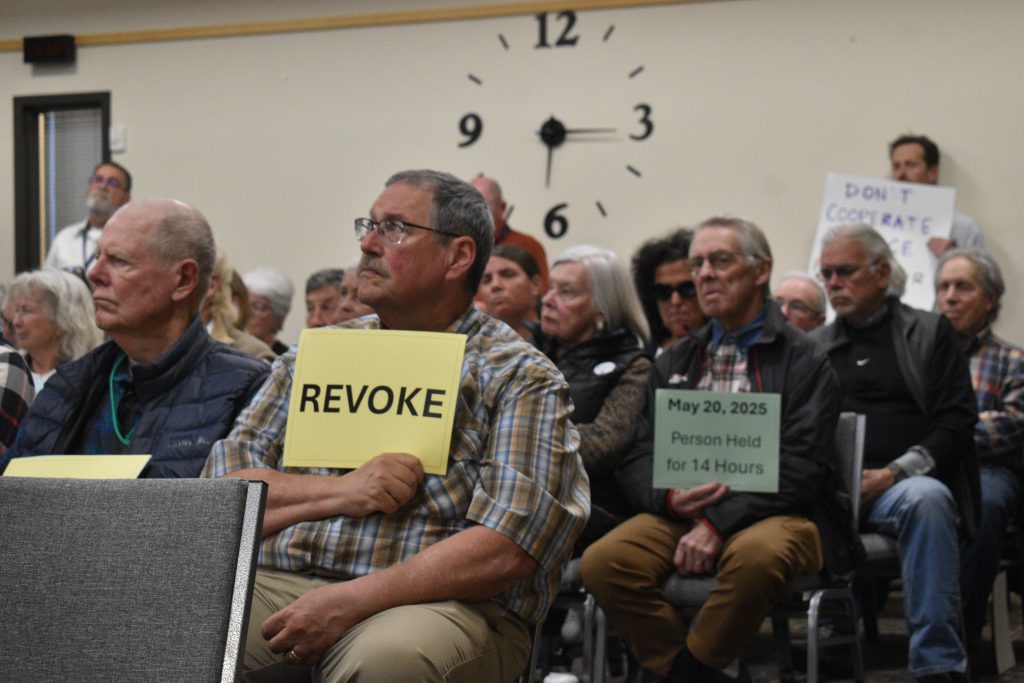
The Glenwood Springs Planning and Zoning Commission voted 5-1 Tuesday to revoke the special use permit for the U.S. Immigration and Customs Enforcement facility at 100 Midland Ave., rejecting city staff’s recommendation to keep the permit in place with corrective measures after federal records showed repeated violations of a 12-hour holding limit.
No representatives from U.S. Immigration and Customs Enforcement, the U.S. Department of Homeland Security or the U.S. General Services Administration attended the meeting.
The vote came after a packed hearing where commissioners weighed a clear local violation against a harder question: whether Glenwood Springs can force a federal agency to comply with its land-use code.
Commissioner Amy Connerton moved to revoke the permit, citing 11 documented cases in which people were held longer than the 12-hour maximum allowed under the special use permit.
Commissioners Connerton, John Houghton, Connie Geiman, Chair Peter Waller and alternate Kyle Jones voted in favor. Commissioner Patrick Corcoran voted against. Vice Chair Joy White was absent, and Jones served in her place.
Before the commission heard from the public or began deliberating, City Attorney Karl Hanlon made clear that revoking the local permit would not necessarily mean the federal facility would close.
“What I need to do is to frame up and set expectations for you and for the public,” Hanlon told commissioners. “I don’t want anybody’s expectations to be that this facility will cease to operate tomorrow, depending on what you do tonight, or that we have a judicial remedy to force that to occur.”
Hanlon said federal agencies are encouraged to cooperate with local governments on zoning and building code issues, but their compliance is largely voluntary. He said the city’s ability to enforce a local land-use decision against the federal government is sharply limited.
News you can trust. Straight to your inbox.
Sign up for our morning newsletter: PostIndependent.com/newsletter
“For me, as the attorney for the city of Glenwood Springs, I have almost no options to enforce that outcome, and I just don’t want there to be any confusion about that,” Hanlon said.
If the decision is not appealed within seven days of the notice being issued, the revocation becomes final locally. If ICE or the General Services Administration does not comply, Glenwood Springs City Council would have to decide whether or not to pursue judicial enforcement, a path Hanlon said would likely be difficult.
“As a city, and primarily as a city council, they’re going to have to decide if they want to instruct me to attempt to take an enforcement action against ICE in court to shut them down,” Hanlon told the Post Independent. “My struggle is that I think the likelihood of success on that is going to be very low because of the protections that are afforded the federal government.”
He said the city would likely end up in federal court if it pursued enforcement.
“Until there’s a judicial decision enforcing our local land-use, they would continue to operate,” Hanlon said. “I don’t have the ability, absent going to court and asking for relief in court and getting an order, I don’t have any way to shut them down.”
Still, Hanlon told commissioners the hearing was important and that the record before them was strong enough to support revocation.
“That having been said, it doesn’t mean that this hearing isn’t incredibly important,” Hanlon added. “It doesn’t mean that there isn’t sufficient record information in the record as it stands, even before the testimony from a ton of people, that you have more than enough evidence to revoke.”
The special use permit was approved in 2003 for the General Services Administration for a detention center for what was then the Bureau of Immigration and Customs Enforcement. The facility has operated in the Midland Center, a commercial building in west Glenwood Springs near Interstate 70, since the early 2000s.
Trent Hyatt, the city’s director of economic and community development, said the original permit required the facility to comply with approved plans and application materials. Those materials repeatedly referred to a 12-hour maximum hold time for detainees.
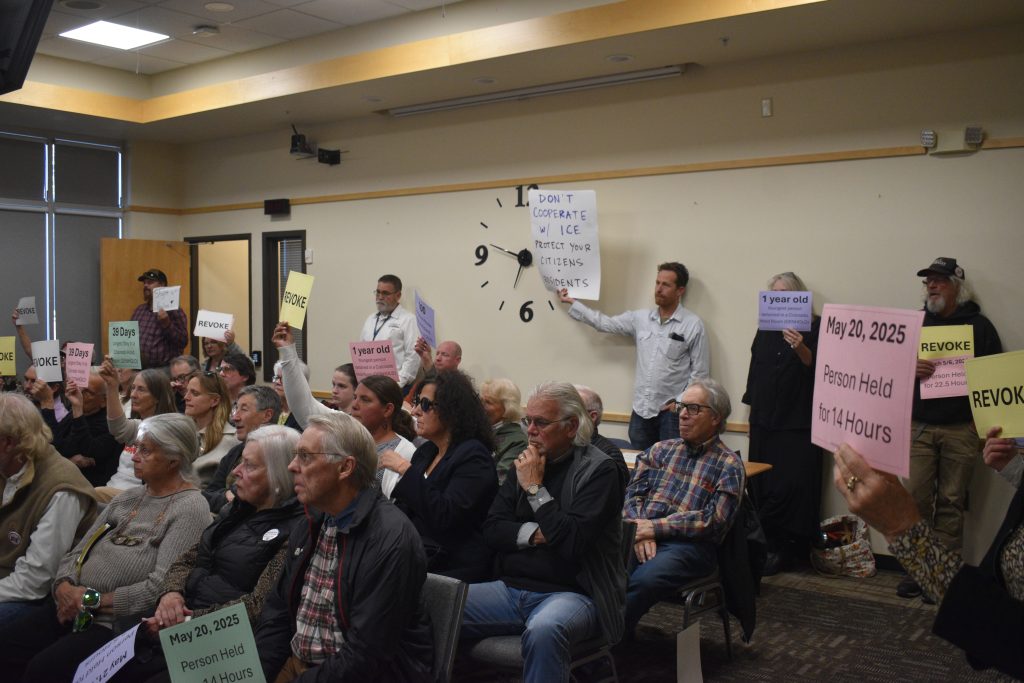
Hyatt said the city received Freedom of Information Act data showing the 12-hour limit had been exceeded at least 11 times in August and September 2025. Additional FOIA releases showed other violations in 2022, 2025 and as recently as March 2026.
Although ICE issued a nationwide waiver in June 2025 allowing some Enforcement and Removal Operations field offices to hold people in temporary holding cells for up to 72 hours, Hanlon said the Glenwood Springs facility’s local approval was still based on a 12-hour maximum. The city’s notice of violation was tied to the special use permit and its approved application materials, which repeatedly referenced the 12-hour limit.
The city issued a notice of violation March 25 to the property owner and tenants. Hanlon said the federal agencies had not responded to the notice and did not appear at Tuesday’s hearing.
In an April 23 staff report, the city recommended requiring corrective measures rather than revoking the permit. The report said the commission had the authority to deny, withhold or revoke the permit, require corrective measures or direct city employees or agents to enter the property and take corrective action, with the cost borne by the violator.That left commissioners with a central question: What would corrective action mean if the federal agencies could ignore it?
The violations were not the only issue before the commission, but they became the clearest legal basis for action. Hyatt said staff viewed the hold-time exceedances as a recurring pattern over time, while also noting that staff understood it was not the agency’s intent to hold people beyond the 12-hour maximum.
Hanlon said federal data showed some exceedances in nearly every year available, with a larger number in 2025, when more people were held at the facility.
The ICE 72-hour waiver, which remains in effect for one year, added another layer to the debate. Hanlon said the federal policy change created problems because the Glenwood Springs facility was approved locally as a short-term holding facility, not an overnight detention center.
“These facilities are not designed for people to be there longer than 12 hours, and not designed as overnight facilities, necessarily,” Hanlon said.
Waller said the 12-hour limit appeared repeatedly in the original 2003 materials from the General Services Administration, making it central to the local approval.
The city’s review of the facility began earlier this year after questions surfaced about its certificate of occupancy. Hyatt said the city contacted tenants Feb. 18 to ask questions and tour the space. On Feb. 25, the city’s building, community development and fire departments inspected the office and detention facility and identified life-safety issues that had to be corrected before a certificate of occupancy could be issued.
Hyatt added the issues were typical for a building more than 20 years old. The building owner’s association hired a licensed contractor to evaluate sprinklers throughout the building, and the city later reinspected the space and issued a certificate of occupancy April 9.
The original facility received a temporary certificate of occupancy in December 2004 for business and I-3 detention and correctional facility uses, but a full certificate of occupancy was never issued at the time. Hyatt said staff believes that was likely an oversight connected to other work in the building and exterior improvements that may still have been pending during the winter.
“This type of situation would be prevented today because of our planning software and how we evaluate temporary certificates of occupancy on a weekly basis,” Hyatt said.
Hyatt said final inspections would not have been approved in 2004 if unresolved life-safety issues remained. He also said the fire marshal required an evacuation plan at the time, and that plan had been provided to the city and posted inside the facility.
By the time public comment opened, the message from the room was overwhelmingly in favor of revocation. Speakers criticized the staff recommendation, questioned whether ICE or DHS would comply with future conditions and said the facility’s operation had harmed local families.
Glenwood Springs Attorney Claire Noone told commissioners that the 12-hour limit was not arbitrary because it separates temporary holding from longer-term detention.
“The 12-hour period is not arbitrary,” Noon said. “It is the line of delineation between a temporary space and a permanent space.”
With the 5-1 vote, commissioners rejected staff’s recommendation for corrective action. The decision starts a seven-day appeal window once the notice of decision is issued.
If the federal agencies do not appeal or comply after the local decision becomes final, city council may have to decide whether to take the matter to court.



Support Local Journalism
Support Local Journalism
Readers around Glenwood Springs and Garfield County make the Post Independent’s work possible. Your financial contribution supports our efforts to deliver quality, locally relevant journalism.
Now more than ever, your support is critical to help us keep our community informed about the evolving coronavirus pandemic and the impact it is having locally. Every contribution, however large or small, will make a difference.
Each donation will be used exclusively for the development and creation of increased news coverage.