Coloradans can celebrate Earth Day by watching 2 celestial phenomena, including a meteor shower
Earth Day will kick off with a planetary conjunction before dawn and will be capped by the Lyrids Meteor Shower after dark

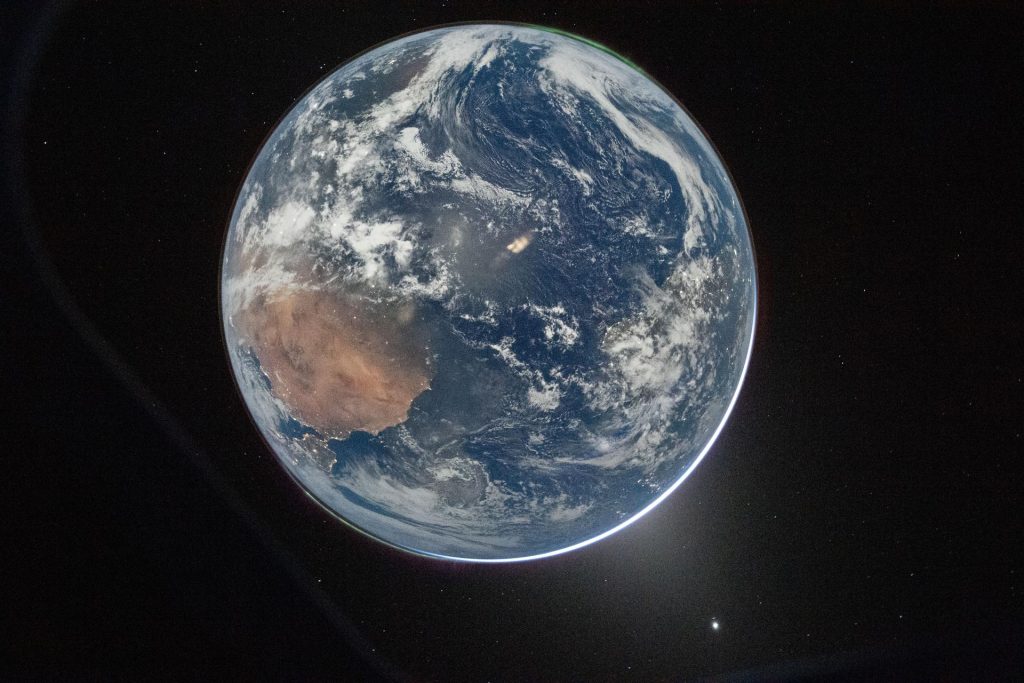
National Aeronautics and Space Administration/Courtesy photo
Coloradans who look up at the night sky this Earth Day could catch a glimpse of two celestial phenomena.
Colorado astronomy guide Mark Laurin said that the holiday on Wednesday, April 22, will be “book ended” by cosmic occurrences: A planetary conjunction before dawn and a meteor shower after dusk.
“The cosmos and the solar system gives us a point of reference to see ourselves as part of a much bigger system,” Laurin said. “On Earth Day, we see ourselves in relation to the cosmos. We see that we are part of something and Earth is something worth protecting.”
A member of the Denver Astronomical Society and the Astronomical League, Laurin is also an adjunct instructor with Keystone Science School. He leads astronomy and stargazing events in Colorado under the nickname Astro Mark.
Laurin noted that the National Aeronautics and Space Administration’s Artemis II mission that circumnavigated the moon earlier this month has renewed American’s interest in our solar system and outer space. Astronauts trained for the Artemis II mission in northwestern Colorado in the months leading up to the April 1 launch.
Artemis II was the first human-crewed flight since the agency’s first lunar program, Apollo, had its last flight 56 years ago. The modern lunar mission captured high-resolution photos of the Earth that harkened back to famous photos of Earth taken by the Apollo missions more than half a century ago.
The “Earthrise” photo taken by Apollo 8 on Dec. 24, 1968 is often credited with sparking the modern environmental movement and leading to the first Earth Day on April 22, 1970, according to the nonprofit Earth Day Network.
While NASA has framed the Artemis II mission as a “crucial step toward eventually sending crews on to Mars,” Laurin said that this Earth Day should serve as a reminder that this is the only planet we have.
He suggested reflecting on the importance of protecting our home planet, while watching neighboring planets rise above the horizon in the morning, then watching the debris of a centuries-old comet burn up as shooting stars in the atmosphere.
“Why are we so enamored with going and colonizing another planet? Because we’re afraid of destroying the one we’ve got,” Laurin said. “Wouldn’t it be cheaper to just take care of our home and address the issues here?”
Here’s how to witness the planetary conjunction and meteor shower on Earth Day:
Planetary conjunction
A planetary conjunction is an astronomical event where two or more planets appear close together in the night sky, as observed from Earth.
On Earth Day, Mars, Saturn and Mercury will be visible to the naked eye close together just before dawn, Laurin said. He noted that Neptune will also be visible, but only with binoculars or a telescope.
“Get up with your morning coffee and just watch them rise,” Laurin said.
To spot the planetary conjunction, look toward the eastern horizon just before sunrise, Laurin said. Since the mountains tend to block part of the horizon in Colorado, he suggested looking for the conjunction around 6:30 a.m., when the planets should be high enough off the horizon to be visible.
Mars, which will be a soft pinkish-red color, will be the easiest to spot as it will hug the eastern horizon, Laurin said. Mars will form a triangle with Mercury, which will appear with a faint peach or pinkish-white color, and Saturn, which will be a muted gold or soft yellow color, he said. Unlike stars, planets don’t twinkle but instead shine with a steady light.
Using binoculars, Neptune will also be visible as part of the conjunction. Laurin said Neptune will be along the same line as Mercury and Saturn, but further to the observers’ right side of the sky. Neptune will be pale blue in color.
The planetary conjunction will be visible before dawn everyday through about April 23.
Lyrids Meteor Shower
The Lyrids Meteor Shower will peak on the night of April 22 and continue through April 29.
Unfortunately, Laurin noted that some of the weaker meteors that occur during the shower will be washed out by light of Jupiter and the moon, which will be about one-quarter full. Still, he estimated that stargazers could see up to 10 shooting stars per hour.
“The moon and Jupiter are going to wash out some of the dimmer meteor showers,” Laurin said, “but the fire balls, the long streakmakers, the bullseyes, those you’ll be able to see.”
A meteor shower is caused by debris that is left over from a comet that passed Earth, often centuries ago, Laurin said. As Earth rotates in its orbit around the sun, it passes through that debris and small particles of ice and dust burn up in the atmosphere, creating shooting stars, he said.
The Lyrids Meteor Shower is caused by debris from Comet C/1861 G1 Thatcher, a long-period comet that orbits the sun every 415 years, according to NASA. Humans have observed the meteor shower caused by this comet for nearly 2,700 years.
To view the meteor shower, stargazers should look toward the northeast to find the radiant point, or the point from which the meteors appear to emanate from anytime after sunset on April 22, Laurin said. He suggested scanning the sky to the north for meteors, while looking away from the moon to minimize the impact of its light.
The best views of the meteor shower may be in the early morning hours of April 23, between roughly 3 to 4 a.m. when the moon has set, Laurin said.
“That’s what astronomy and looking at the night sky does for me, it just reminds me of my place in the universe,” Laurin said. “It’s an important place. I’m part of the universe, but in (relation) to the universe, I’m just one small grain of sand hitting the atmosphere and burning up in a meteor shower.”

Roaring Fork watershed’s low snowpack runoff will change fishing, rafting this summer
Throughout Colorado this past winter season, ski areas experienced low snow totals; many of them closed earlier than projected. Bookings were down. Snowpack was measurably depleted.







Support Local Journalism
Support Local Journalism
Readers around Glenwood Springs and Garfield County make the Post Independent’s work possible. Your financial contribution supports our efforts to deliver quality, locally relevant journalism.
Now more than ever, your support is critical to help us keep our community informed about the evolving coronavirus pandemic and the impact it is having locally. Every contribution, however large or small, will make a difference.
Each donation will be used exclusively for the development and creation of increased news coverage.